Selecting the right plastic material is one of the most important decisions in any injection molding project. The material influences product performance, manufacturing efficiency, product life, and overall project cost. Choosing the right material early in product development can reduce design changes, improve manufacturability, and optimize production.
Whether you are developing a consumer product, electrical enclosure, automotive component, agricultural product, or industrial part, this guide covers the plastic materials most commonly used in injection molding.
Material selection is an important part of Moldrite's Design for Manufacturability (DFM) process. Our engineering team works with customers to evaluate product requirements, manufacturability, tooling considerations, and commercial objectives before identifying suitable materials for production.
How to Choose the Right Plastic Material
Material selection begins by understanding what the product needs to achieve — whether that is cost, impact resistance, electrical insulation, outdoor durability, transparency, or dimensional stability. In many projects, several materials are evaluated before identifying the most suitable solution.
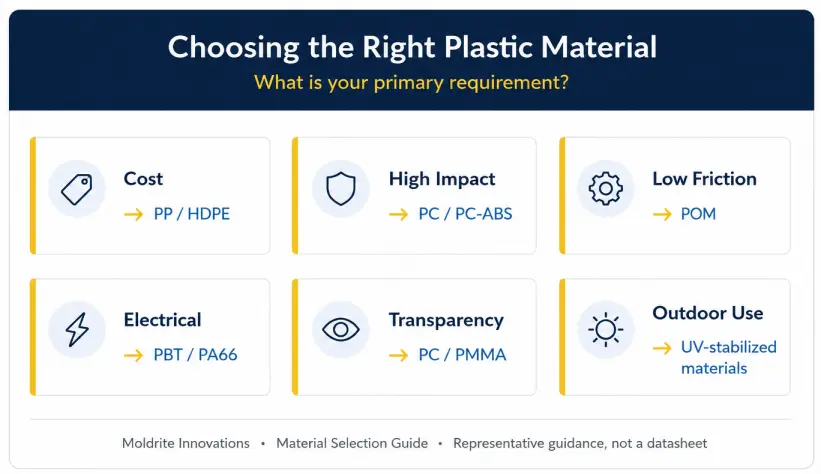
What Should Be Considered?
| Consideration | Why It Matters |
|---|---|
| Mechanical Performance | Strength, stiffness, and impact resistance required for the application. |
| Operating Environment | Temperature, moisture, chemicals, and outdoor exposure. |
| Regulatory Requirements | Food-contact, electrical, or industry-specific compliance where applicable. |
| Appearance | Surface finish, colour, texture, and transparency. |
| Manufacturing Efficiency | Material processability, tooling considerations, and production cost. |
Plastic Materials We Process
The materials below represent the plastics most commonly processed for custom injection molding projects. The final material selection depends on your product's functional, environmental, and commercial requirements.
Polypropylene (PP)
Moldrite ExperienceMoldrite has thin-wall PP molding experience for applications where part-weight reduction, cycle efficiency, and material economy are important.
- Cost-sensitive products
- Chemical resistance
- Food-contact grades
Consumer products, packaging, agriculture
Related: Agriculture & Hydroponics · DFM Review
High-Density Polyethylene (HDPE)
Moldrite ExperienceMoldrite has manufactured components using HDPE for applications where chemical resistance, outdoor durability, and manufacturing efficiency were key design considerations.
- Chemical resistance
- Outdoor durability
- Cost-effective production
Containers, agricultural equipment, water management
Related: DFM Review
ABS (Acrylonitrile Butadiene Styrene)
Moldrite ExperienceMoldrite has produced precision ABS enclosures and PCB housings where surface finish, impact resistance, and dimensional stability were important design considerations.
- Excellent surface finish
- Good impact resistance
- Dimensional stability
Electrical housings, consumer products, enclosures
Related: Electrical Components · PCB Housing Case Study
Polycarbonate (PC)
Moldrite ExperienceUsed for highly transparent components across applications such as lubrication equipment, water heaters, transformer assemblies, and electrical meter assembly parts, where optical clarity, impact resistance, and dimensional stability are important.
- High impact resistance
- Optical transparency
- Heat resistance
Transparent covers, lighting, meter & instrument parts, safety products
PC-ABS (PC / ABS Blend)
Moldrite ExperienceSelected for automotive applications where impact performance, dimensional stability, and surface finish were key considerations.
- Impact + surface finish
- Dimensional stability
- Automotive & electrical
Automotive parts, enclosures, PCB housings
Related: Electrical Components
POM (Acetal)
Moldrite ExperienceUsed in conveyor system applications where low friction, wear resistance, and dimensional stability mattered to long-term performance.
- Low friction
- Wear resistance
- Precision components
Gears, rollers, conveyor & sliding mechanisms
Related: DFM Review
PA6 / PA66 (Nylon)
Moldrite ExperienceMoldrite has produced electronic enclosures in Nylon 6 (PA6); PA6 and PA66 are used where mechanical strength and dimensional stability matter, with glass-filled grades for added structural performance.
- High mechanical strength
- Good wear resistance
- Glass-filled grades available
Automotive, electrical connectors, industrial parts
Related: Electrical Components
Polybutylene Terephthalate (PBT)
Moldrite ExperienceCommonly assessed for electrical applications where insulation and dimensional consistency are key requirements.
- Electrical insulation
- Dimensional stability
- Low moisture absorption
Connectors, switchgear, sensor housings
Related: Electrical Components
HIPS (High-Impact Polystyrene)
Moldrite ExperienceRegularly processed for consumer and industrial applications where appearance, processability, and commercial viability are important.
- Excellent surface finish
- Easy processing
- Cost-effective
Consumer products, consumer appliances, packaging
Other Materials We Support
Depending on product requirements, Moldrite also supports projects using TPE, PMMA (Acrylic), ASA, SAN, GPPS, LDPE, and application-specific engineering compounds. Material is always selected to suit the product's requirements rather than the availability of a particular resin.
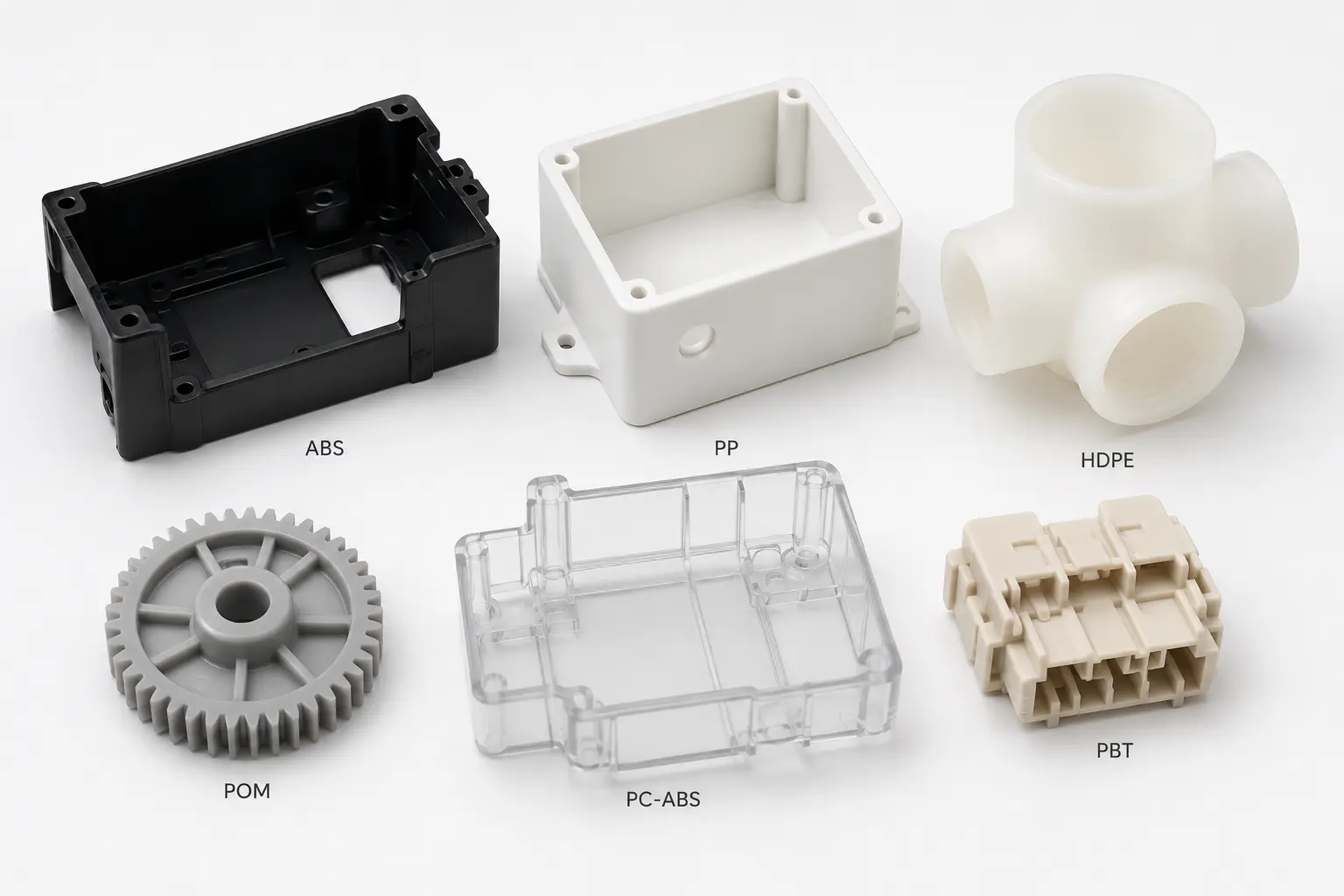
Material Selection as Part of Design for Manufacturability (DFM)
Selecting the right material is only one part of a successful project. Product geometry, wall thickness, tooling design, processing conditions, and operating environment all influence the final selection.
At Moldrite, material selection is reviewed as part of our Design for Manufacturability (DFM) process — helping improve manufacturability, optimize tooling, and confirm the material meets the product's functional requirements. Involving material selection early can reduce development time and manufacturing risk. Learn more about our Design for Manufacturability (DFM) services.
ABS vs PC-ABS · PP vs HDPE · PA66 GF30 vs PBT GF30
Need Help Choosing the Right Plastic Material?
Whether you are developing a new product or refining an existing design, share your drawings or project requirements with our team. As part of our Design for Manufacturability (DFM) process, we will evaluate suitable material options alongside tooling, manufacturability, and production considerations before providing a quotation.
Need Help Choosing the Right Plastic Material?
Share your drawings or requirements and our team will respond with how Moldrite can support your project, along with a quotation.
Frequently Asked Questions
There is no single material suitable for every application. PP, ABS, HDPE, PC, PC-ABS, PA66, PBT, and POM are among the most commonly used materials, with the final selection depending on the product's functional and manufacturing requirements.
There is no single best plastic for injection molding. The most suitable material depends on the product's performance requirements, operating environment, and manufacturing considerations. PP, ABS, PC, PC-ABS, PA66, PBT, and POM are among the most widely used.
Material selection depends on factors such as mechanical performance, operating environment, appearance, regulatory requirements, and manufacturing cost. In many projects, multiple materials are evaluated before selecting the most suitable option.
Engineering plastics such as PBT, PA66, and PC-ABS are widely used for electrical and electronic applications because they offer excellent dimensional stability and insulation properties. Learn more about electrical components injection molding.
Outdoor applications often require materials with good weather resistance and UV stability. The most suitable material depends on the product's operating environment and expected service life.
Several thermoplastics are available in food-contact grades, including polypropylene (PP). The final material selection depends on the intended application and applicable regulatory requirements.
Yes. Material selection influences mold design, cooling requirements, processing conditions, and production efficiency. Selecting the right material early can help optimize both tooling and manufacturing costs.
In many cases, several materials may meet the same functional requirements. The final selection depends on balancing performance, manufacturability, product life, and commercial objectives.
Yes. Material selection forms part of our Design for Manufacturability (DFM) approach. Our engineering team works with customers to identify suitable materials based on product performance, manufacturing requirements, and commercial objectives.
Looking for a Specific Plastic Material?
Explore our engineering resources on material selection, Design for Manufacturability (DFM), electrical component manufacturing, agricultural injection molding, and cost optimization to learn how material choice influences product performance and production efficiency.