Home About Services DFM Review Case Study — PCB Housing Portfolio Blog Injection Molding Glossary Injection Molding Cost in India Reduce Plastic Part Cost Contact Us Electronics & Semiconductor Precision Division →
What You Get Considerations DFM Samples Moldflow When DFM is Done FAQ Send Drawing

Design for Manufacturability (DFM) Review for Injection Molding

Engineering review before tooling — identifying cost, manufacturability, and quality risks early. Catch design issues at concept stage, not at first trial.

For OEMs, product designers, and procurement teams evaluating tooling feasibility.

What You Get

DFM Review Deliverables

Actionable engineering feedback before tool steel is cut.

Each DFM review covers the core engineering checks that determine whether a part will mold reliably, meet tolerance, and remain cost-efficient at volume.

Draft Angle Analysis

Verifies all surfaces have adequate draft for clean ejection from the mold.

Wall Thickness Review

Checks uniformity to prevent sink marks, warpage, and cycle time issues.

Gate Location Recommendation

Optimal gate placement for flow balance, cosmetic surface, and weld line management.

Material Selection Guidance

Polymer recommendations matched to mechanical, thermal, and cost requirements.

Tooling Concept

Parting line, slides, lifters, and core pulls evaluated for tooling complexity and cost.

Risk Identification

Warpage, sink marks, weld line position, and air trap risks flagged before tooling.

Engineering Considerations

Key Engineering Considerations in DFM

Beyond standard checks, DFM involves evaluating how part geometry interacts with tooling constraints and production stability. Critical considerations include uniform flow behavior, avoidance of stress concentrations, rib-to-wall ratios, and maintaining consistent shrinkage behavior.

Design decisions at this stage directly impact mold complexity, cycle time, dimensional stability, and long-term tool reliability.

  • Geometry simplification to reduce tooling complexity
  • Uniform flow path and balanced filling
  • Rib and boss design for strength without sink
  • Draft strategy for reliable ejection
  • Tolerance feasibility vs material behavior
  • Cooling feasibility and cycle time impact
Real Engineering Review Samples (Anonymized)

Sample DFM Review (Actual Engineering Work)

Excerpts from actual DFM reviews delivered on customer parts — tooling concept, geometry optimization, and risk identification before tooling.

Actual excerpts from customer projects (anonymized for confidentiality).
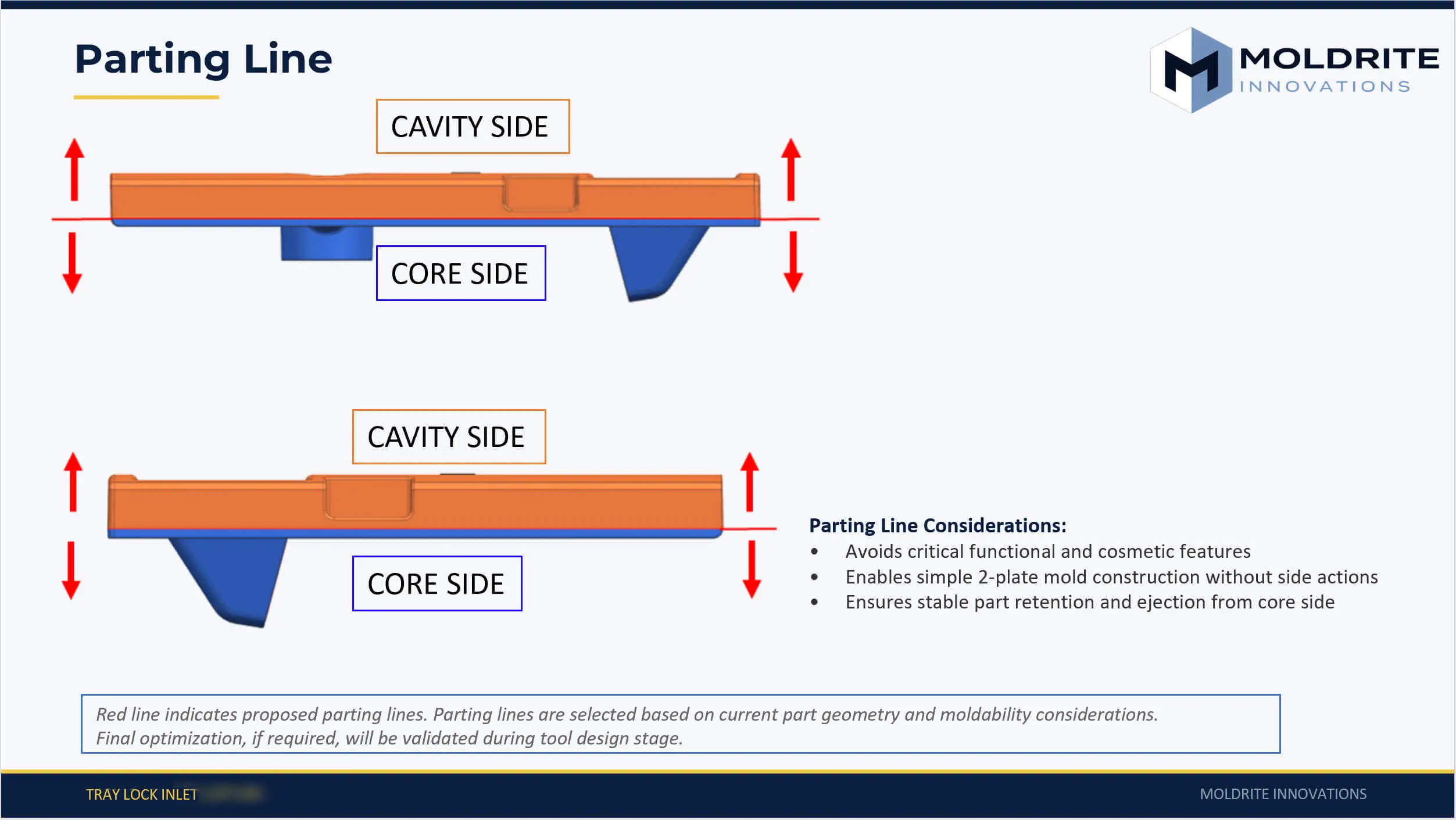
Parting Line Optimization

Parting Line Optimization

Parting line defined based on geometry, cosmetic requirements, and tooling feasibility to ensure stable molding and clean ejection.
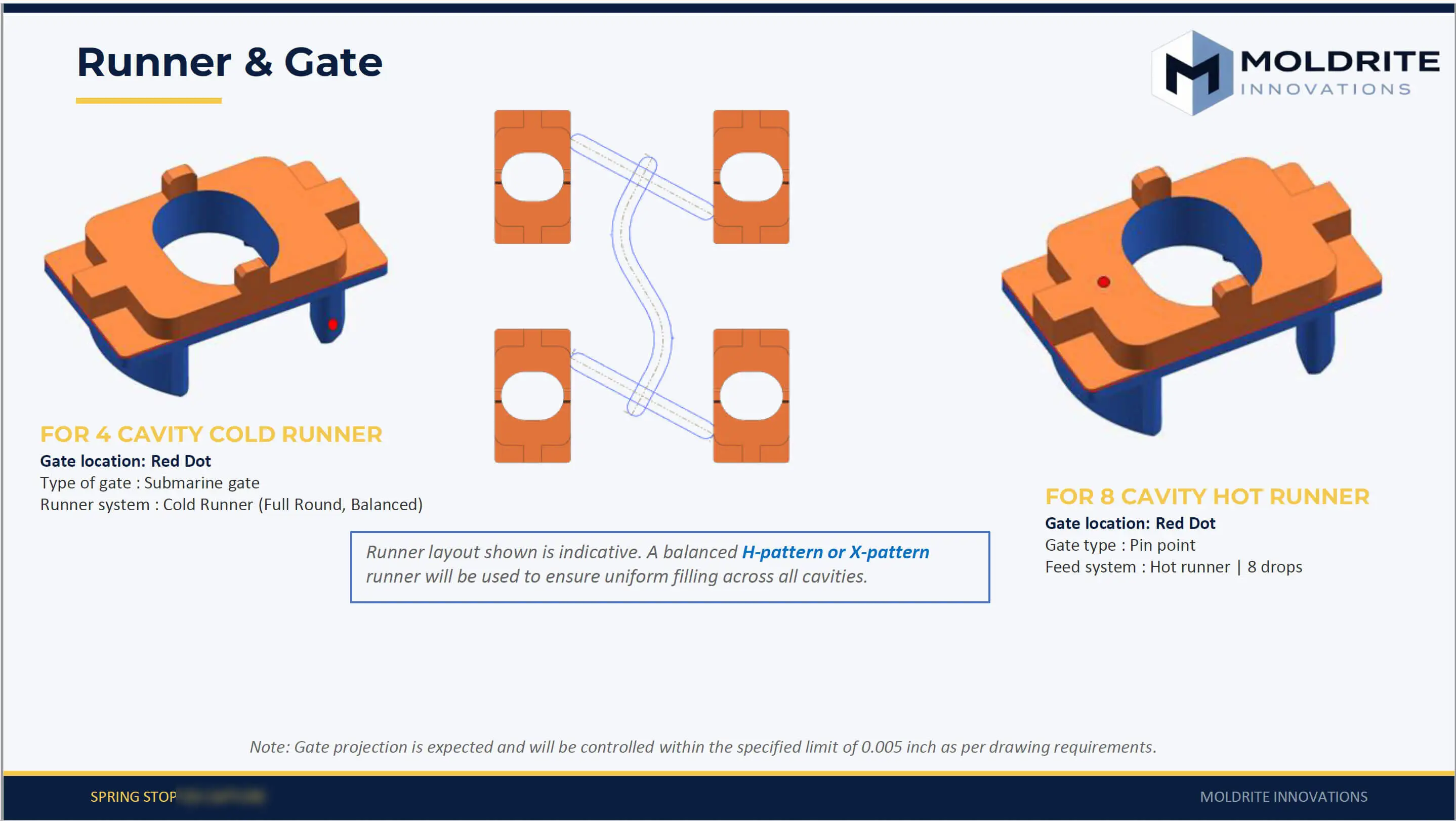
Runner and Gate Design

Runner & Gate Design

Runner layout and gate location selected to achieve balanced filling and minimize flow-related defects.
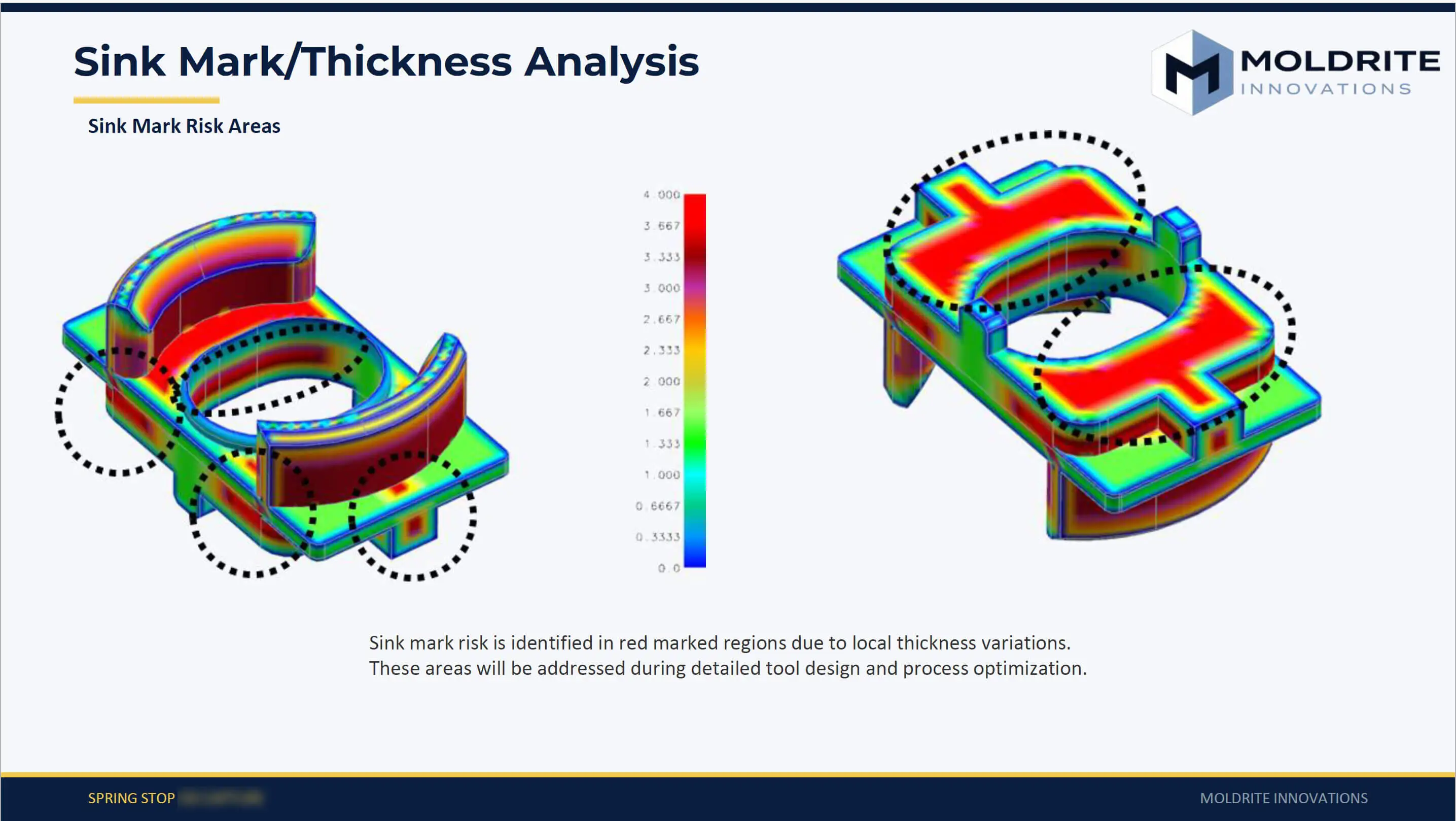
Wall Thickness and Sink Mark Analysis

Wall Thickness & Sink Mark Review

Thickness variations analyzed to identify sink risk areas and guide geometry or process optimization.
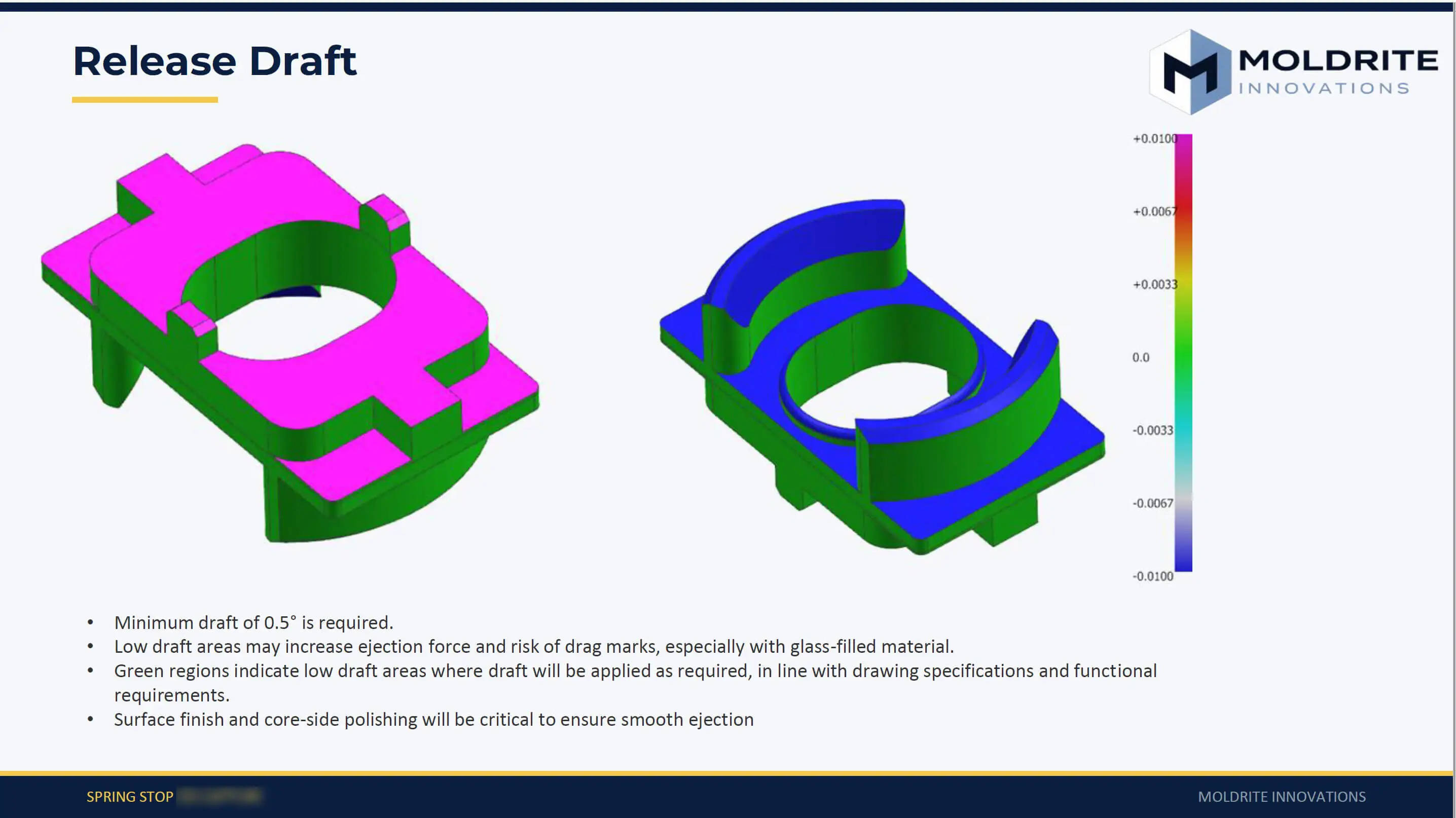
Release Draft Analysis

Release Draft Analysis

Draft evaluated across surfaces to ensure clean ejection and prevent drag or surface damage.
Moldflow Simulation

Filling, Shrinkage & Defect Prediction

Used selectively for complex or tight-tolerance components — validating filling, shrinkage, and weld line behavior before tooling. Simulation outputs are used to refine gate location, packing parameters, cooling layout, and overall process window before tool design is finalized.

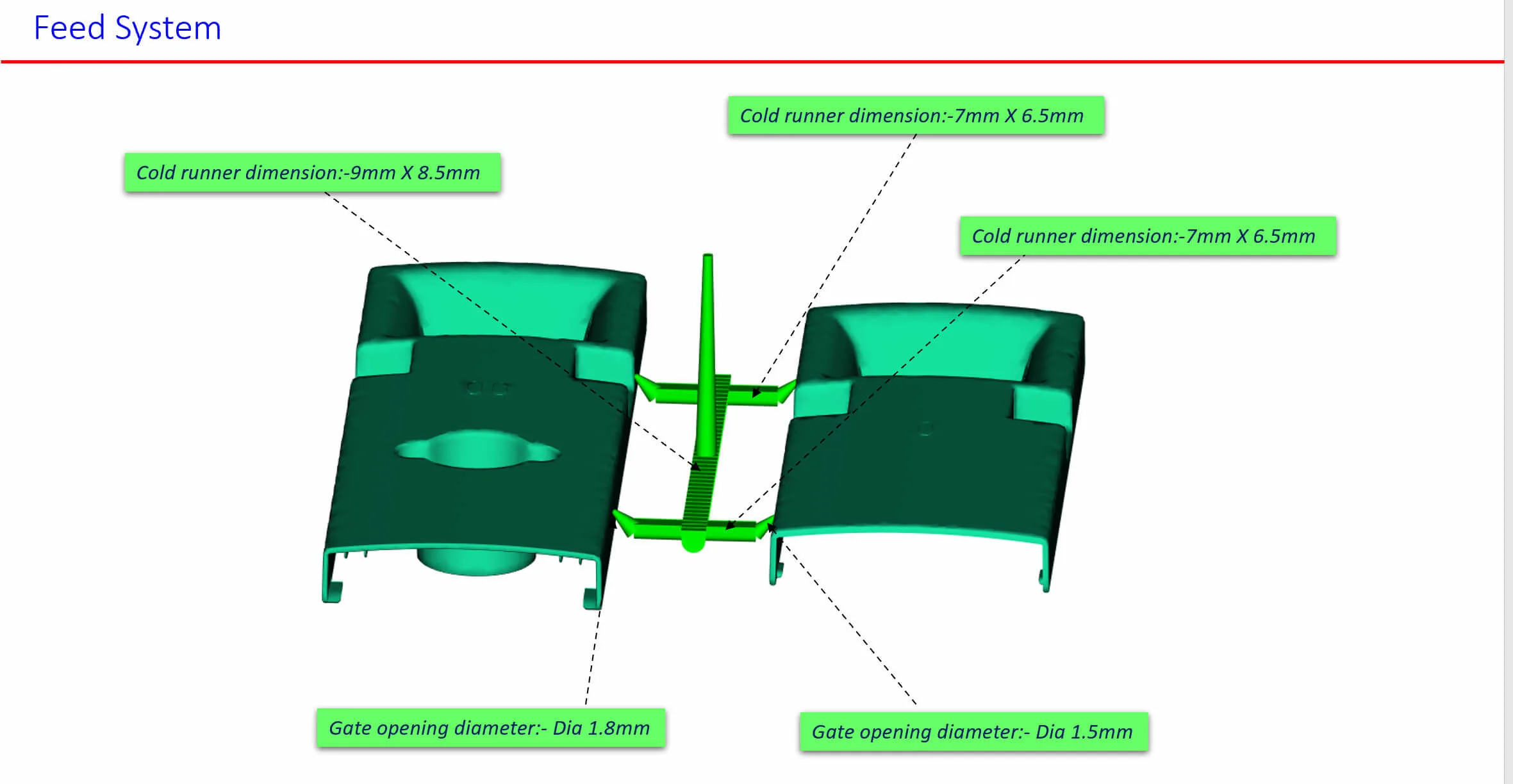
Feed System - Gate and Runner Layout

Feed System

Gate and runner positioned for balanced cavity filling.

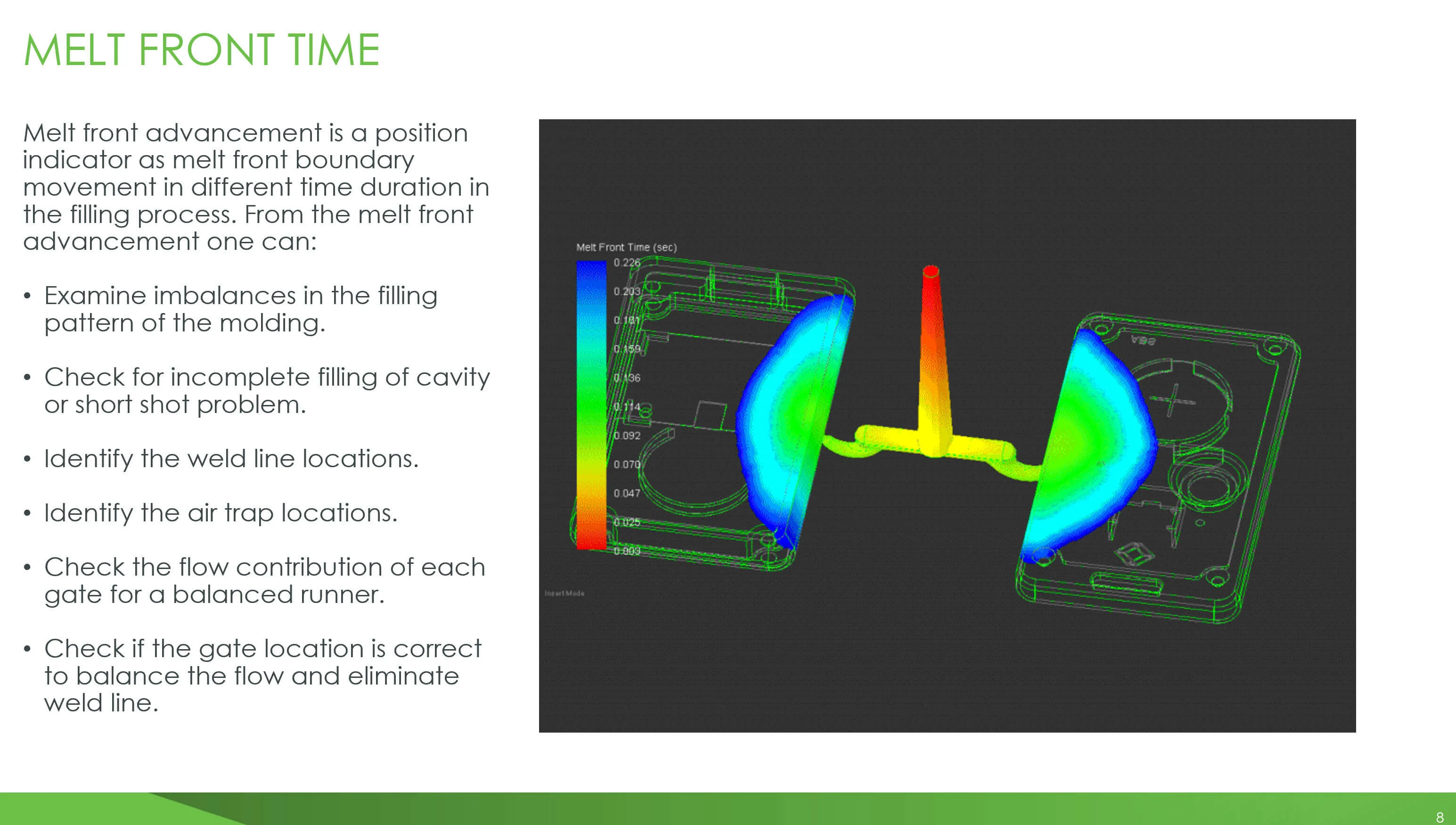
Melt Front Time Analysis

Melt Front Time

Balanced filling behavior validated across cavities.

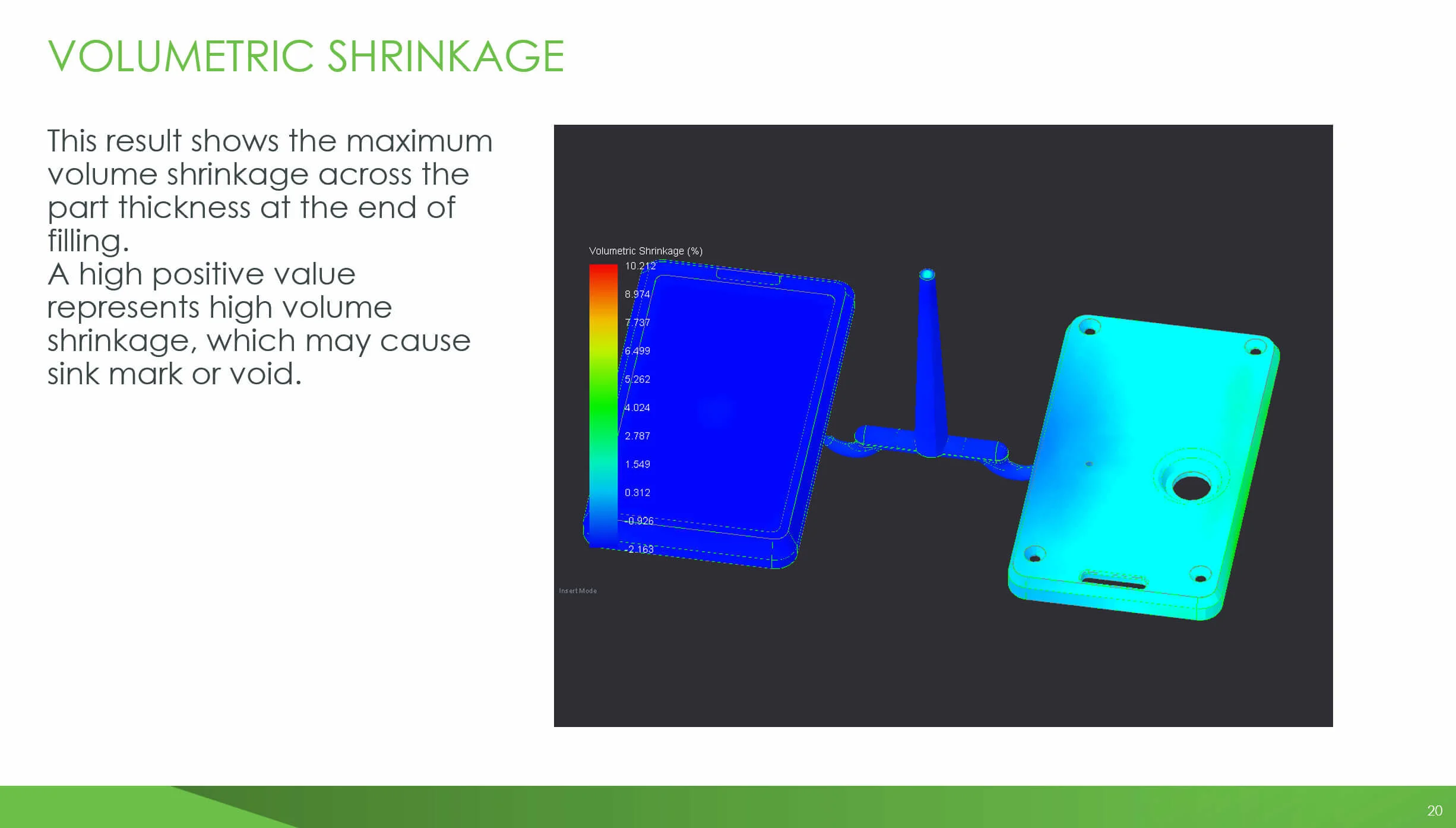
Volumetric Shrinkage Analysis

Volumetric Shrinkage

High-risk shrinkage zones identified for packing and process optimization.

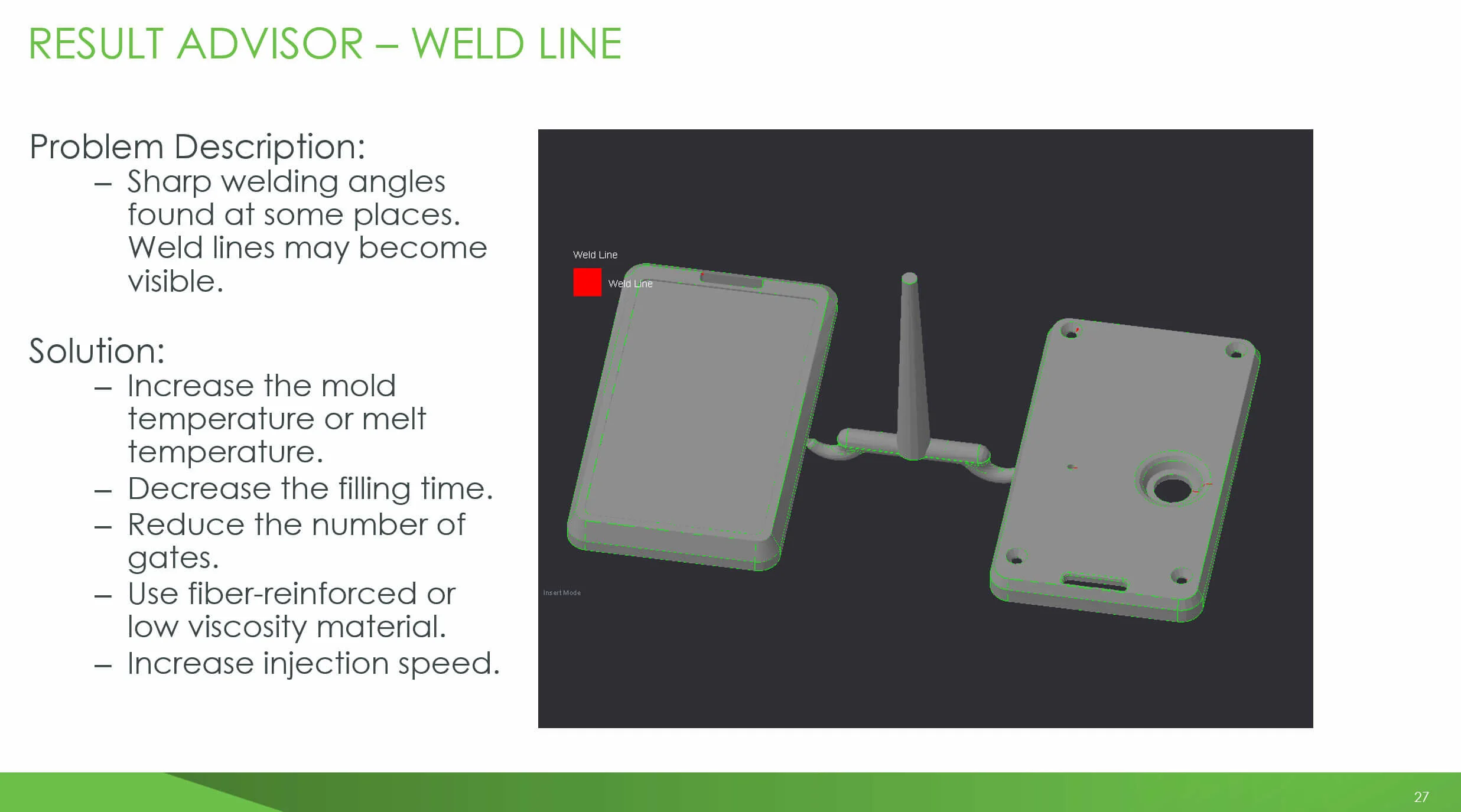
Flow Front and Weld Lines

Flow Front & Weld Lines

Weld line location validated against cosmetic requirements.

Simulation in Practice

How Simulation Supports Tool Design Decisions

Moldflow simulation is not used in isolation — it supports engineering decisions made during DFM. Simulation results are interpreted to validate filling behavior, identify high-pressure regions, and assess shrinkage distribution.

These insights are translated into practical actions such as refining gate size and location, adjusting wall transitions, and optimizing packing and cooling strategies before tool steel is finalized.

  • Fill pattern validation and hesitation zones
  • Pressure drop and clamp force estimation
  • Shrinkage distribution and warpage tendency
  • Weld line positioning vs cosmetic requirements
  • Packing and cooling optimization inputs
When DFM is Done

DFM Happens Before Tool Manufacturing Begins

DFM review is completed before tool manufacturing begins and forms the basis for final tool design approval. This is the most cost-effective stage to resolve design issues — once steel is cut, changes become expensive and time-consuming to implement.

When We Use Moldflow Simulation

Moldflow simulation is used selectively for complex or tight-tolerance components where filling, warpage, or cooling behavior needs validation before tooling. For straightforward parts, the standard DFM review covers the necessary engineering checks without simulation overhead.

Frequently Asked Questions

Common Questions About DFM Review

Quick answers to the questions engineering teams and procurement most often ask before starting a DFM review.

DFM stands for Design for Manufacturability. It is an engineering review of a part design done before tooling, focused on whether the part can be molded reliably, meet tolerance, and remain cost-efficient at volume. The review covers draft angles, wall thickness, gate location, parting line, material selection, and risk areas like sink marks, warpage, and weld lines.

DFM should be done after the part design is reasonably finalized but before tooling begins. Earlier is better — design changes are cheap on the screen, expensive once steel is cut. Most issues identified during DFM cost almost nothing to fix at the design stage but can cost weeks of delay and significant rework if found at first trial or in production.

For a complete DFM review, we need: a 3D model (STEP file preferred, IGES also accepted), 2D drawing if available, target material or material family, expected annual volume, and any critical dimensions or tolerance requirements. STEP files are preferred because they preserve geometry accurately and let us run analysis directly. PDFs and DWGs are also accepted but may need additional clarification.

DFM review identifies geometry issues (insufficient draft, undercuts, thick sections), filling and flow risks (gate location, weld line position, air traps), dimensional risks (warpage, shrinkage, sink marks), tooling complexity (slides, lifters, parting line), and material compatibility issues. For complex or tight-tolerance parts, we extend the review with Moldflow simulation to validate filling, packing, and cooling behavior.

Yes. We have demonstrated ±0.02 mm tolerance capability in select precision applications, including a precision ABS electronic housing case study. Tight tolerance work requires careful DFM — gate location, cooling layout, and material choice all affect dimensional consistency. For these parts, we use Moldflow simulation to validate the design before tooling and tune process parameters during production. Final tolerances are validated during sampling (T0/T1) and controlled through process capability during production.

Yes. For most projects, we perform an initial DFM assessment alongside the quotation to identify potential risks, tooling complexity, and cost drivers early. A detailed DFM report follows after order confirmation.

Typical DFM reviews are completed within 24–48 hours depending on part complexity. More complex assemblies or simulation-supported reviews may take longer.

DFM review is typically included as part of our tooling package — we engage early because catching issues before tool manufacturing protects both timeline and cost. For standalone DFM consultations (where tooling is being done elsewhere), we can provide DFM as a separate engagement. The exact commercial arrangement is finalized along with the tooling quote.

Send Your Drawing for DFM Review

Share your part drawing or 3D model. Our engineering team will review and respond within 24 hours.

All designs are handled confidentially and can be covered under NDA if required.

DFM review is typically included with tooling programs; standalone reviews available on request.

STEP files preferred for fastest review · PDF, DWG, IGES also accepted