Injection Molding for Agriculture Products: Designing Plastic Components for Long-Term Outdoor Performance
Molded solutions built to withstand UV, impact, and real-world conditions — engineered for reliability across every season.
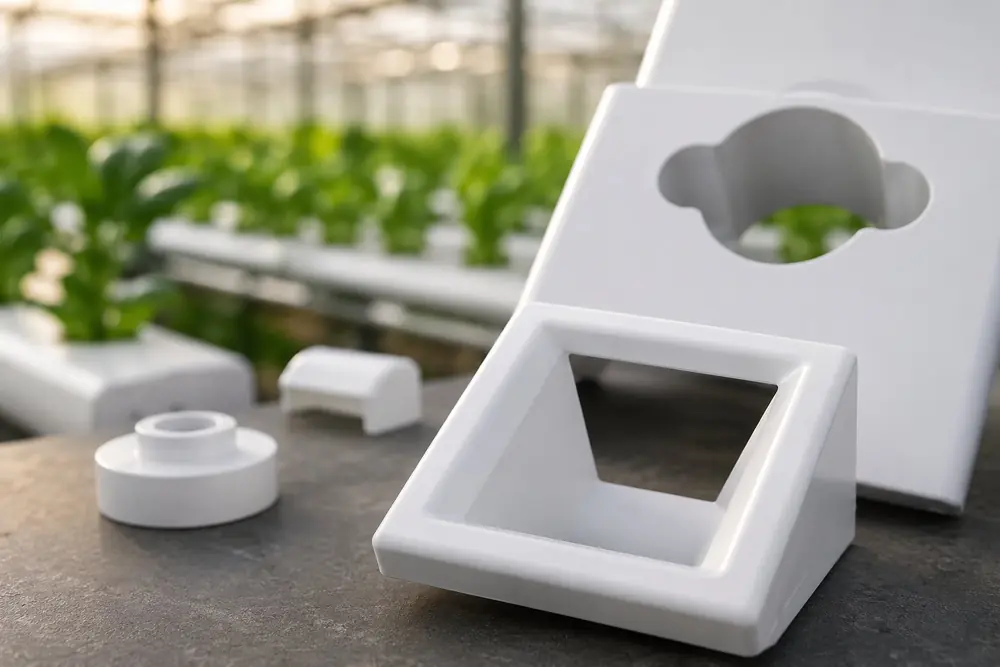
Molded solutions built to withstand UV, impact, and real-world conditions — engineered for reliability across every season.
Agricultural plastic products increasingly operate in demanding outdoor environments where appearance, functionality, and durability are expected to remain consistent throughout years of service. Requirements such as long-term UV stability, impact resistance, food-contact suitability, and functional performance often need to be achieved simultaneously rather than in isolation.
Unlike indoor applications, agricultural components may be exposed to sunlight, moisture, repeated handling, temperature variations, and occasional mechanical impacts. Product performance therefore depends not only on manufacturing capability, but also on material selection, validation, and Design for Manufacturability (DFM). At Moldrite, we support agricultural product companies through DFM, tooling, material selection, and precision injection molding of components designed for real-world agricultural environments.
| Capability | Details |
|---|---|
| Industries | Agriculture, Hydroponics & Controlled Environment Farming |
| Materials | Application-specific engineering polymers |
| Outdoor Validation | ASTM G154 accelerated weather testing experience |
| Impact Validation | IK06 evaluation experience (IEC 62262) |
| Food Contact | TÜV food-contact compliance evaluations |
| Production | Low to high-volume manufacturing |
| Export | Global supply capability |
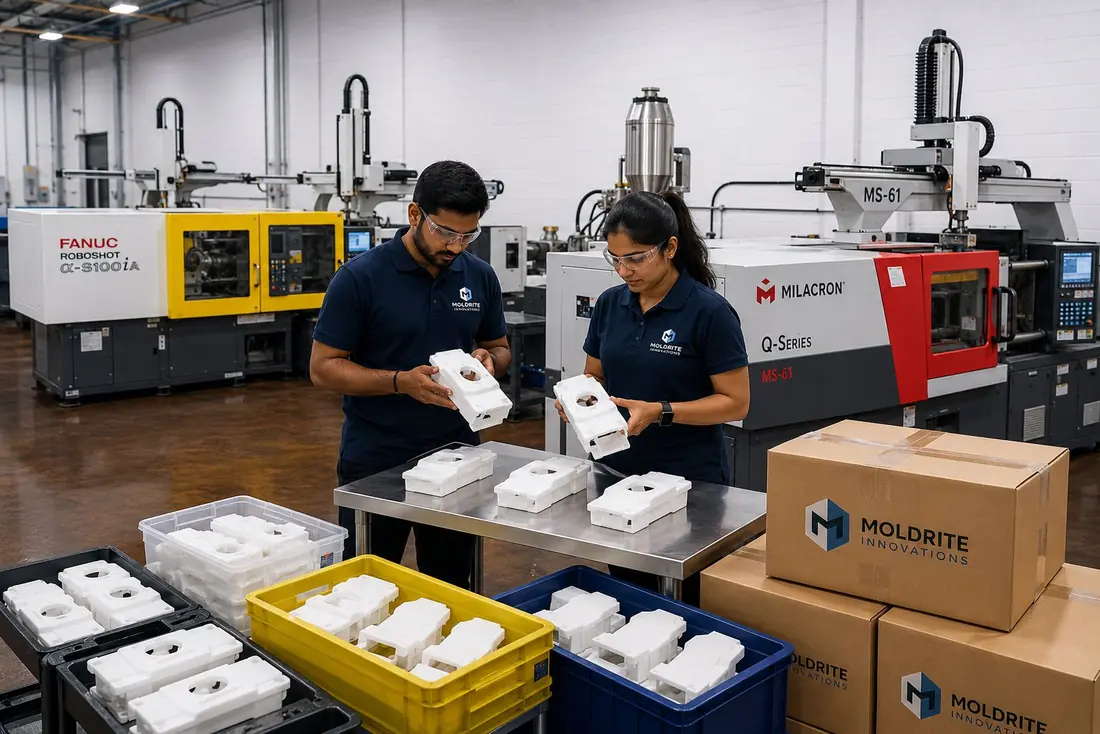
Agricultural applications vary depending on operating environment and performance expectations. We manufacture a range of molded hydroponic and agricultural products, including:
Outdoor agricultural products frequently require balancing multiple performance targets simultaneously.
| Requirement | Engineering Challenge |
|---|---|
| Extended outdoor service life | Resistance to environmental degradation |
| Colour stability | Long-term weatherability |
| Impact resistance | Material toughness and durability |
| Sliding assemblies | Surface interaction and dimensional control |
| Food-contact suitability | Independent migration validation requirements |
| Seasonal temperature variation | Dimensional stability |
| Cost competitiveness | Performance versus manufacturability |
Achieving these requirements simultaneously often requires balancing material selection, validation activities, and manufacturing considerations rather than relying solely on standard commodity solutions — achieving the required performance targets while managing manufacturing economics. This brings injection molding cost considerations and strategies for reducing plastic part cost without compromising performance into the conversation.
Choosing the right polymer is critical for outdoor agricultural applications. Our Material Selection Assistant suggests materials commonly considered for parts like yours, as a starting point.
This hydroponic application required the development of a plastic component intended for long-term outdoor operation while maintaining appearance, functionality, and safety requirements. The product was developed for an international customer serving multiple global markets with demanding outdoor performance expectations.
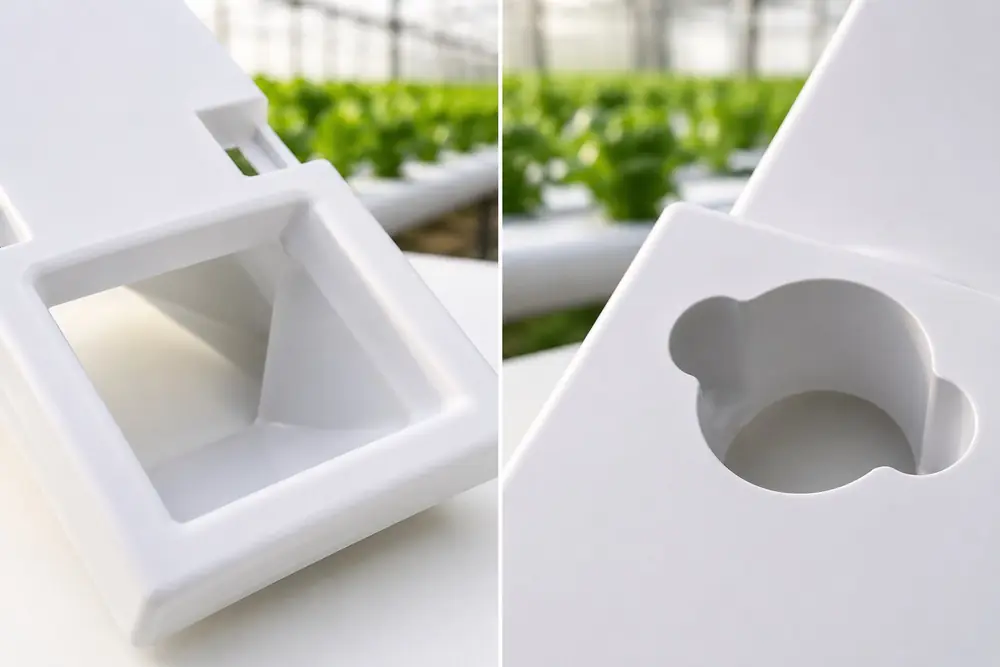
The project objectives included:
| Requirement | Performance Objective |
|---|---|
| Outdoor service life objective | Approximately 10 years |
| Operating temperature range | Validated from −20°C to +45°C (winter and summer) |
| Colour retention | White appearance stability |
| Impact performance | IK06 requirements under IEC 62262 |
| Food-contact suitability | Migration compliance requirements |
| Functional performance | Smooth sliding interaction between components |
Meeting these objectives required careful evaluation of material behaviour, manufacturability, and validation requirements throughout the product development process. Importantly, the challenge was not achieving a single requirement in isolation, but balancing durability, appearance, impact performance, functionality, and manufacturability within a commercially viable product.
Share your drawings or specifications and our team will respond with how Moldrite can support your project, along with a quotation.
Validation activities formed an important part of the development program and helped support confidence in long-term field performance. The development program incorporated independent laboratory evaluations to assess durability, impact performance, and food-contact suitability.
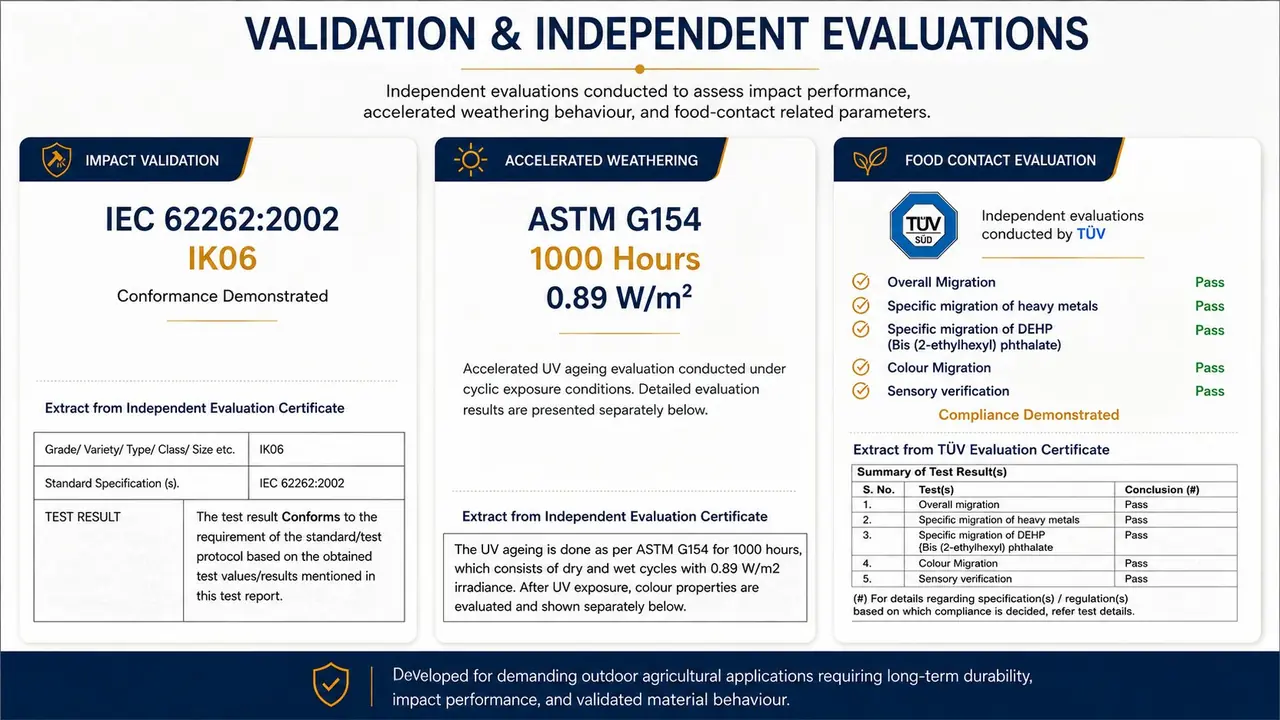
| Validation Activity | Outcome |
|---|---|
| ASTM G154 accelerated UV weathering | Independent evaluation completed |
| IK06 impact testing (IEC 62262) | Conformance demonstrated |
| Overall migration testing | TÜV evaluation completed |
| Heavy metal migration | Compliance demonstrated |
| DEHP migration | Compliance demonstrated |
| Colour migration | Compliance demonstrated |
| Sensory verification | Compliance demonstrated |
Accelerated UV weathering was performed in accordance with ASTM G154 using cyclic exposure conditions to evaluate colour performance and support outdoor durability objectives for the intended application. Food-contact suitability assessments included migration and sensory evaluations relevant to the application requirements.
Agricultural products operating outdoors may experience conditions very different from controlled indoor environments. Structured validation can help reduce risks associated with:
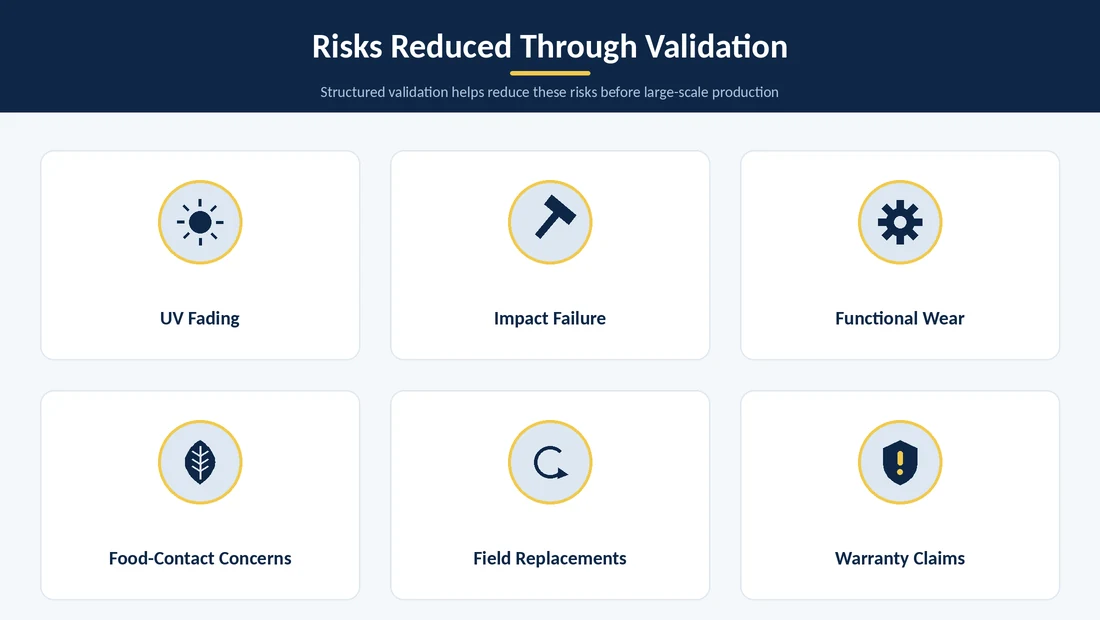
Validation activities allow product teams to make informed engineering decisions before large-scale production.
Moldrite supports agricultural product development through a combination of engineering involvement and manufacturing capability. Our approach includes:
Rather than viewing molding as a standalone production activity, we work to understand application requirements and identify potential risks early in the development cycle.
Explore our complete injection molding services including tooling, production, and assembly support.
Yes. Outdoor agricultural products can be designed for extended service life through appropriate material selection, validation, and manufacturing controls.
IK06 is an impact classification defined under IEC 62262 and is used to evaluate resistance to mechanical impacts under specified testing conditions.
ASTM G154 is an accelerated weathering test method used to evaluate the effects of UV exposure and moisture cycles on polymer performance.
White outdoor agricultural products can be engineered for long-term colour stability through appropriate material selection and validation. Accelerated weathering evaluations help assess performance under simulated outdoor exposure conditions.
Yes. Depending on the application, migration and sensory evaluations may be conducted to demonstrate compliance with relevant requirements.
Examples include hydroponic components, irrigation accessories, greenhouse components, covers, structural interfaces, and custom agricultural products.
Yes. Material selection is often reviewed during DFM activities to balance performance, manufacturability, and cost objectives.
Yes. Injection molding allows products to be developed for specific functional, dimensional, and environmental requirements.
Validation activities help reduce the risk of premature failures and provide confidence that the product can meet its intended performance objectives.
Engineers new to plastics can also explore our injection molding glossary.
Whether you're developing hydroponic components, outdoor agricultural products, or application-specific molded assemblies, share your drawings or specifications and our team will respond with how Moldrite can support your project, along with a quotation.
Learn more about Moldrite as an injection molding manufacturer in Bangalore.