Many OEMs and product developers struggle when selecting an injection molding supplier in India. At first glance, most suppliers appear similar — machines, materials, and pricing all look comparable on paper. The real difference lies in engineering capability, process control, and long-term reliability.
If you're searching for injection molding companies in India, the challenge is not finding suppliers — it's identifying the right one. India has hundreds of molders across every cluster and price tier, and the question OEMs really need to answer is: which supplier will perform consistently when your project moves from prototype to production?
This guide explains how to evaluate injection molding companies in India from a practical, engineering perspective. The factors below are the ones that consistently determine project success in our experience working with OEMs on injection molded components.
What Actually Matters When Selecting a Supplier
1. Tooling and DFM Capability
A reliable supplier should not just "make parts" but actively support design for manufacturability (DFM). The quality of the tool is what separates a one-time success from years of consistent production.
Look for companies that:
- Suggest gate locations and part improvements before quoting
- Identify shrinkage, warpage, and sink risks early
- Optimize for cycle time and unit cost during tool design
- Discuss runner balance and cooling layout, not just cavity count
Poor DFM leads to repeated tool corrections, delays, and significant cost escalation downstream. A supplier who quotes without asking for 3D data or DFM review is signalling low engineering involvement — treat that as a red flag.
Cost optimization often begins at the design stage — see practical methods for reducing plastic part cost through design and process decisions before tooling commitment.
2. Material Expertise
Different applications require different polymer families, and material behaviour during processing varies significantly:
- PP / HDPE — FMCG, packaging, consumer goods
- ABS / PC / PC-ABS — electrical enclosures, consumer products
- PA66 GF / PBT GF — engineering and automotive components requiring strength and dimensional stability
- POM / PEEK — precision and high-performance applications
A capable supplier understands material shrinkage, drying requirements, melt flow behaviour, and the trade-offs between similar grades — not just the material name on the data sheet.
3. Process Control and Consistency
Injection molding is not just about making the first sample — it's about maintaining consistency across thousands of production cycles. Process control is where most supplier differences become obvious.
Key indicators of strong process control:
- Stable cycle times across shifts
- Documented and locked process parameters
- Low rejection rates (typically below 2% for consumer polymers, below 5% for engineering-grade materials)
- Repeatable dimensions across cavities and runs
Consistency is often more important than initial pricing. In many projects we have seen, dimensional variation or inconsistent quality is linked to lack of process control rather than tooling alone. This is where a supplier's engineering approach makes a significant difference.
4. Multi-Cavity and High-Volume Capability
For production projects, tooling design matters as much as molding capability. Single-cavity molds are fine for prototyping or low-volume specialty parts — but for any meaningful production run, multi-cavity tooling drives the unit economics.
Evaluate:
- Multi-cavity mold experience and balanced runner systems
- Ability to maintain dimensional consistency across all cavities
- Hot runner experience for high-volume production
- Cycle time optimization without compromising part quality
This directly impacts cost efficiency and scalability. A supplier who can only operate single-cavity tools is a different category of partner from one running 4-cavity, 8-cavity, or hot runner systems reliably.
5. Quality and Measurement Systems
Quality is more than ISO certification on the wall. What matters is whether the supplier has:
- Defined incoming material inspection processes
- Documented dimensional inspection at first-off, in-process, and final stages
- Understanding of GD&T, critical dimensions, and tolerances
- Calibrated measurement equipment (CMM, profile projector, height gauges)
- Traceability across batches
This becomes especially important for engineering components, regulated industries (medical, automotive), and assembled products where one out-of-spec part can stop a downstream line.
6. Export Capability and Compliance Experience
If your project involves export or your end customer is global, supplier export readiness becomes critical. Look for:
- Documented export experience to multiple countries
- Familiarity with country-specific compliance (REACH, RoHS, FDA where applicable)
- Capability to issue Certificates of Conformity, material data sheets, and IMDS submissions
- Clear export packing standards and documentation handling
- English-language engineering and customer communication
Suppliers who only serve domestic customers may lack the documentation discipline that export projects require — the technical capability may be present, but the operational readiness is not.
India-Specific Considerations for OEM Buyers
India has emerged as a strong destination for injection molding, supported by a skilled engineering workforce, competitive tooling costs (often 40–60% lower than Europe and the US), and rapidly growing export capability. Manufacturers across the country today serve global OEMs in automotive, electrical, electronics, FMCG, healthcare, and consumer product segments — with increasing focus on quality systems, process control, and international compliance.
Why Bangalore Has Become a Central Manufacturing Hub
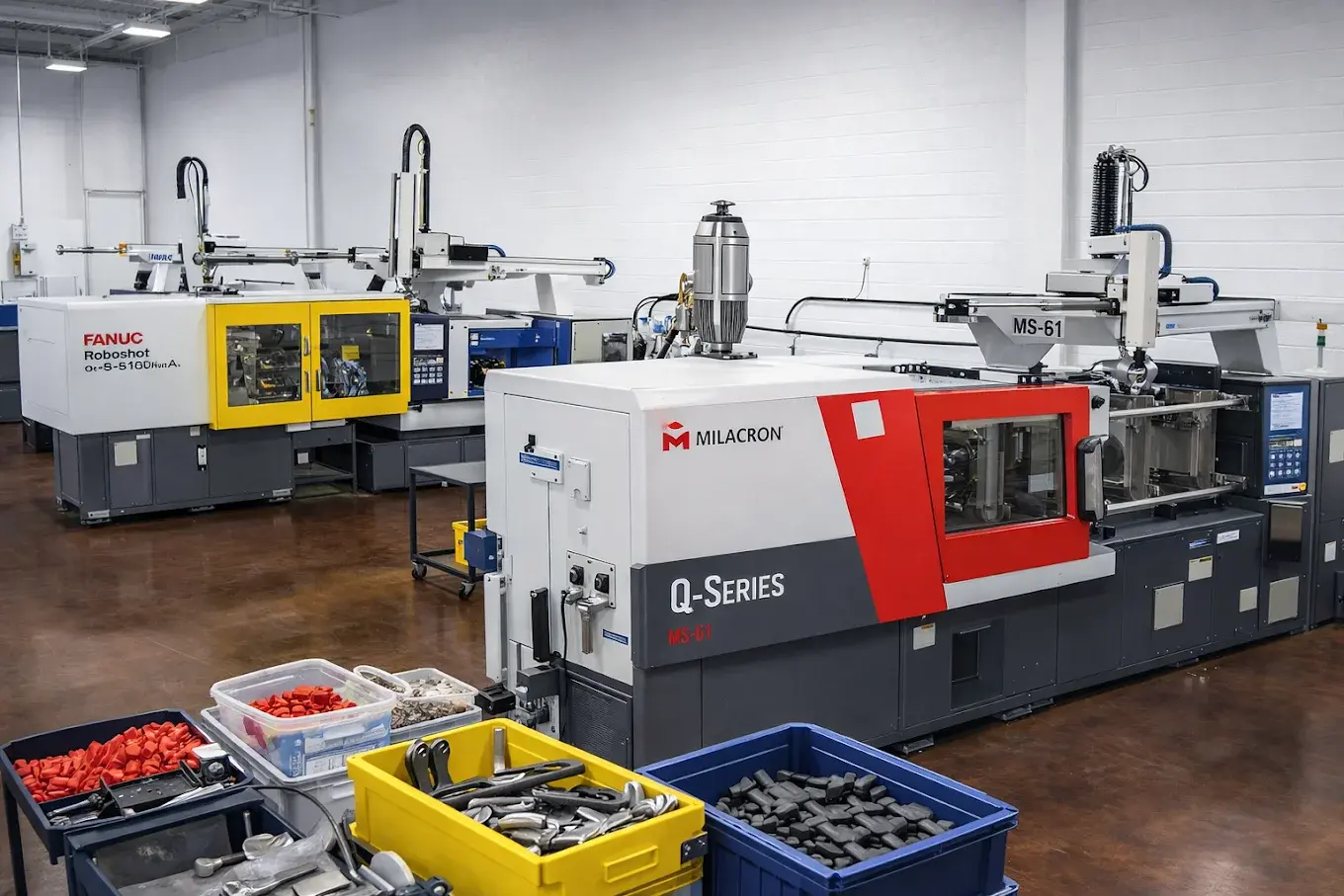
While injection molding capability exists across multiple Indian cities, Bangalore has emerged as one of the most versatile and strategically located manufacturing hubs in the country. The city's Peenya Industrial Area — one of the largest industrial estates in Asia — concentrates a deep network of injection molders, toolrooms, and engineering suppliers within a single ecosystem.
What makes Bangalore particularly strong for OEM injection molding projects:
- Multi-industry depth — Bangalore-based molders serve electronics, semiconductor, automotive, EV, FMCG, healthcare, and industrial equipment customers from the same shop floors. This breadth means suppliers here have seen a wider range of tolerance, material, and volume requirements than single-segment specialists in other regions.
- Proximity to OEM assembly units — major OEMs across electronics, automotive, EV, and consumer goods have assembly operations in and around Bangalore. This proximity reduces logistics cost, shortens iteration cycles, and enables faster supplier visits during ramp-up.
- EV and electronics concentration — with India's EV ecosystem expanding rapidly and Bangalore positioned as the country's electronics capital, injection molders here have growing experience supporting next-generation product programs — from precision battery housings to advanced electronics enclosures.
- High-volume production capability — the cluster includes molders capable of running automated multi-cavity production for FMCG and consumer-volume programs, alongside engineering-grade precision suppliers.
- Engineering talent pool — Bangalore's deep engineering workforce (tooling, polymer processing, quality, automation) makes the city particularly strong for projects requiring DFM input, validation, and continuous process improvement.
- Export readiness — established export infrastructure, English-language engineering communication, and proximity to Bengaluru's international airport and Chennai/Mangalore ports support international customers efficiently.
For OEMs evaluating injection molding partners in India — whether the project involves precision components, high-volume FMCG production, automotive assemblies, or export-grade electronics — Bangalore offers the rare combination of multi-industry capability, OEM proximity, engineering depth, and international readiness within a single geographic cluster.
Several Indian manufacturers based in Bangalore — including Moldrite Innovations, located in the Peenya Industrial Area — are supporting global OEMs with end-to-end molding solutions from DFM through production.
If you're specifically looking for a supplier in Bangalore, see our dedicated page on injection molding company in Bangalore for facility details, capabilities, and how we work with OEMs locally.
Practical Considerations for International Buyers
- GST and invoicing — reputable suppliers issue compliant tax invoices and handle export documentation cleanly
- MSME registration — many quality mid-sized molders are MSME-registered, offering structured pricing and reliable delivery
- Payment terms — advance for tooling is standard; staged production payments are negotiable based on volume and relationship
- IP protection — India offers stronger IP protection than several other low-cost regions, with reasonable enforcement for industrial designs and trade secrets
Red Flags to Watch For
When evaluating any injection molding supplier in India, these signals usually indicate problems ahead:
- Supplier quotes without asking for 3D data or running a DFM review
- Inability to explain gate location strategy or tooling approach in technical terms
- No structured T0 / T1 trial process or sample approval workflow
- Extremely low pricing compared to market — usually means corners cut on tooling, material, or process
- Vague answers on rejection rates and quality metrics
- No documented case studies or reference customers
Common Mistakes OEMs Make
When selecting a supplier, the most expensive mistakes are usually:
- Choosing based on lowest cost only — almost always leads to rework, line stoppages, or supplier change midway
- Ignoring tooling design capability — cheap tooling is the fastest way to expensive production
- Not evaluating production consistency — first sample is easy, the 50,000th part is what reveals the supplier
- Skipping technical discussions during RFQ stage — if a supplier won't engage technically before the order, they won't engage technically after either
- Treating the relationship as transactional — the best results come from suppliers treated as engineering partners
For cost considerations specifically — tooling cost ranges, part cost factors, and pricing transparency — see our detailed injection molding cost in India guide. Understanding cost structure helps separate fair pricing from quotes that look attractive but hide trade-offs.
Top Injection Molding Companies in India — What to Compare
When comparing injection molding companies in India, the goal is not to find a long list of suppliers — but to evaluate which one fits your project requirements best.
Instead of focusing on brand names or size alone, compare suppliers based on these practical factors:
- Engineering involvement — Do they provide DFM input before quoting?
- Tooling capability — Good tooling support with proven experience in multi-cavity, hot runner, and complex tools
- Process control — Ability to maintain consistency across production batches
- Material expertise — Experience with your specific polymer and application
- Quality systems — Measurement infrastructure and inspection discipline
- Scalability — Can they handle volume ramp-up without compromising quality?
- Export readiness — Documentation, communication, and compliance capability
A smaller engineering-focused supplier may outperform a larger production-focused company depending on your project stage — especially for precision or development programs.
The right choice depends on your priorities: cost, consistency, speed, or long-term reliability.
Quick Reference: Matching Supplier Type to Project
Different project types call for different supplier profiles. Use this as a starting point for narrowing down the right partner type:
| Project Type | Volume | What to Prioritize | Best-Fit Supplier Type |
|---|---|---|---|
| Prototype / Pilot | Low (under 1,000) | DFM input, flexibility, fast iteration | Small toolroom or prototype-friendly molder |
| OEM Production | Medium (10K–500K) | Process control, tolerance discipline, traceability | Mid-size precision molder |
| FMCG / Consumer High-Volume | High (1M+ annual) | Automation, cycle time, multi-cavity hot runner | Large-scale supplier with hot runner expertise |
| Export / Global OEM | Medium to High | Compliance, documentation, English-language engineering | Export-focused supplier with proven international track record |
| Engineering / Precision | Variable | Tight tolerance capability, GD&T understanding, validation | Engineering-led molder with measurement infrastructure |
How to Evaluate the Best Injection Molding Companies in India
If you've reached this point, you have a working framework for evaluating injection molding companies in India. The best suppliers will check most of these boxes consistently:
- They request 3D data and run a DFM review before quoting
- They discuss tooling, gating, and runner strategy in technical terms
- They demonstrate process control through documented cycle times and rejection rates
- They show experience across your specific polymer family and application
- They have measurement infrastructure aligned with your tolerance requirements
- They handle export documentation and international compliance smoothly
- They communicate in clear, structured technical English
The strongest signal is usually how a supplier responds to your first technical conversation. If they engage substantively with your design before talking price, you've likely found a partner. If they quote without questions, treat that as data.
Final Thoughts
Selecting the right injection molding partner is not just a sourcing decision — it is an engineering decision. The supplier you choose will influence your part design, production economics, and ramp-up timeline for the life of the program.
A capable supplier will improve your design before tooling is cut, reduce cost over time through optimization, and ensure consistent production at scale. A purely price-driven supplier will give you the cheapest first piece — and the most expensive ten thousandth.
The right partner is rarely the cheapest one. It's the one whose engineering capability matches the demands of your project.
Need Help Evaluating Your Project?
Share your drawings or requirements — we'll review and suggest the most cost-effective manufacturing approach.
Frequently Asked Questions
If you are new to injection molding terminology, refer to our injection molding glossary for key concepts before reading further.
What should I look for in an injection molding company in India?
Beyond price and machine capacity, evaluate tooling and DFM capability, material expertise, process control and consistency, multi-cavity experience, quality systems, and export readiness. Strong engineering capability separates reliable suppliers from price-driven shops.
How do I evaluate a supplier's tooling capability?
Ask about gate location strategy, runner balance, cooling design, and the supplier's T0/T1 trial process. A capable supplier will discuss tooling approach in technical terms during the RFQ stage and request 3D data before quoting.
Why does process control matter more than initial pricing?
Initial pricing represents the first piece. Production reliability comes from stable cycle times, controlled process parameters, and low rejection rates (typically below 2% for consumer polymers, 5% for engineering grades). Inconsistency leads to rework, line stoppages, and higher long-term cost than savings on unit price.
Is injection molding in India suitable for export-quality production?
Yes. Many Indian manufacturers serve global OEMs in automotive, electrical, FMCG, and healthcare. Look for suppliers with documented export experience, established quality systems (ISO 9001 minimum, IATF for automotive), and English-language technical communication. India offers competitive tooling cost, English-speaking engineering teams, and strong IP protection compared to other low-cost regions.
What are common mistakes OEMs make when selecting an injection molding supplier?
The most common mistakes are choosing on lowest cost alone, ignoring tooling design capability, skipping technical discussions during RFQ, and not validating production consistency. Each of these leads to higher long-term cost through rework, delays, and dimensional issues during scale-up.
Related Reading
Continue exploring — these guides go deeper into specific aspects of injection molding decisions: