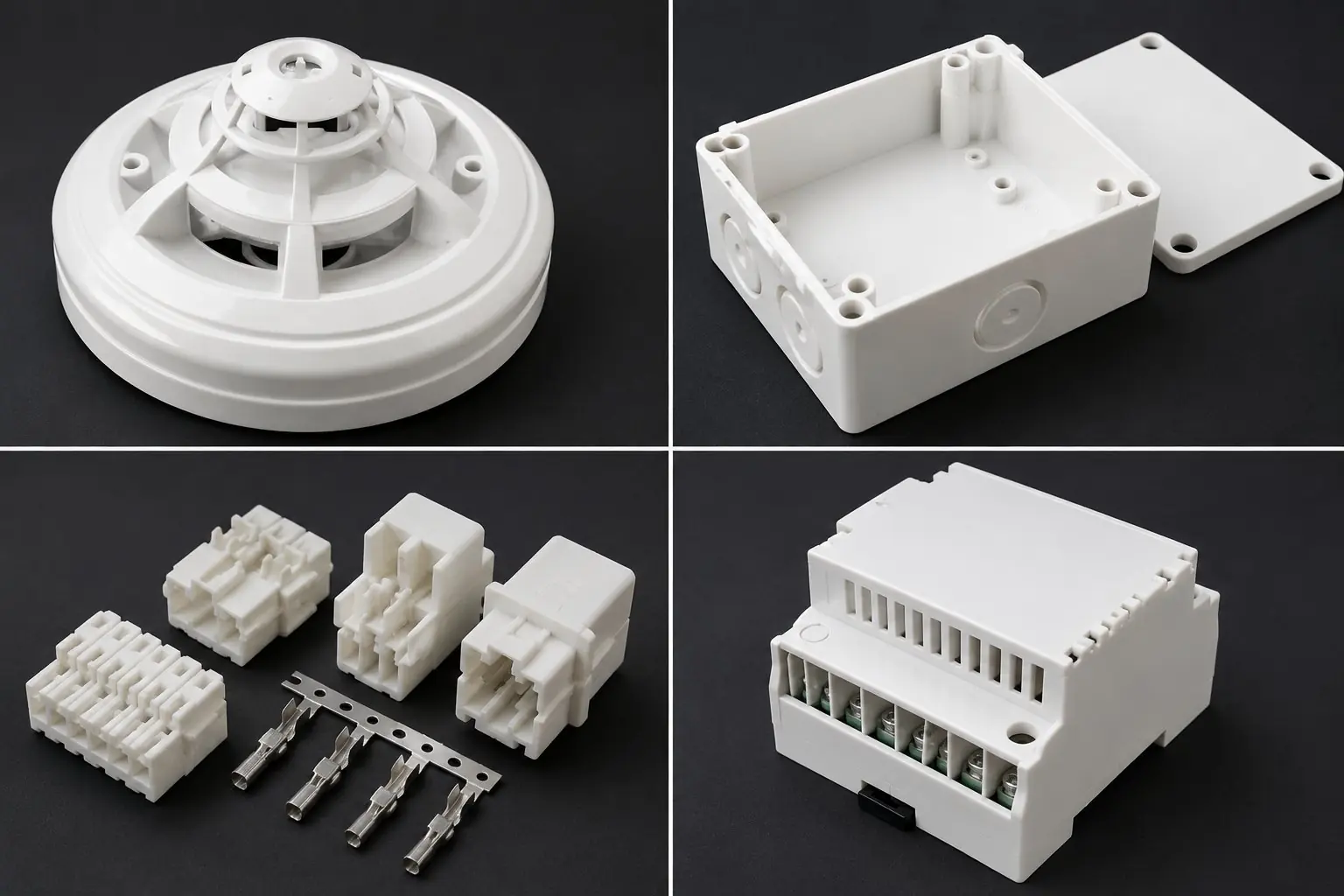
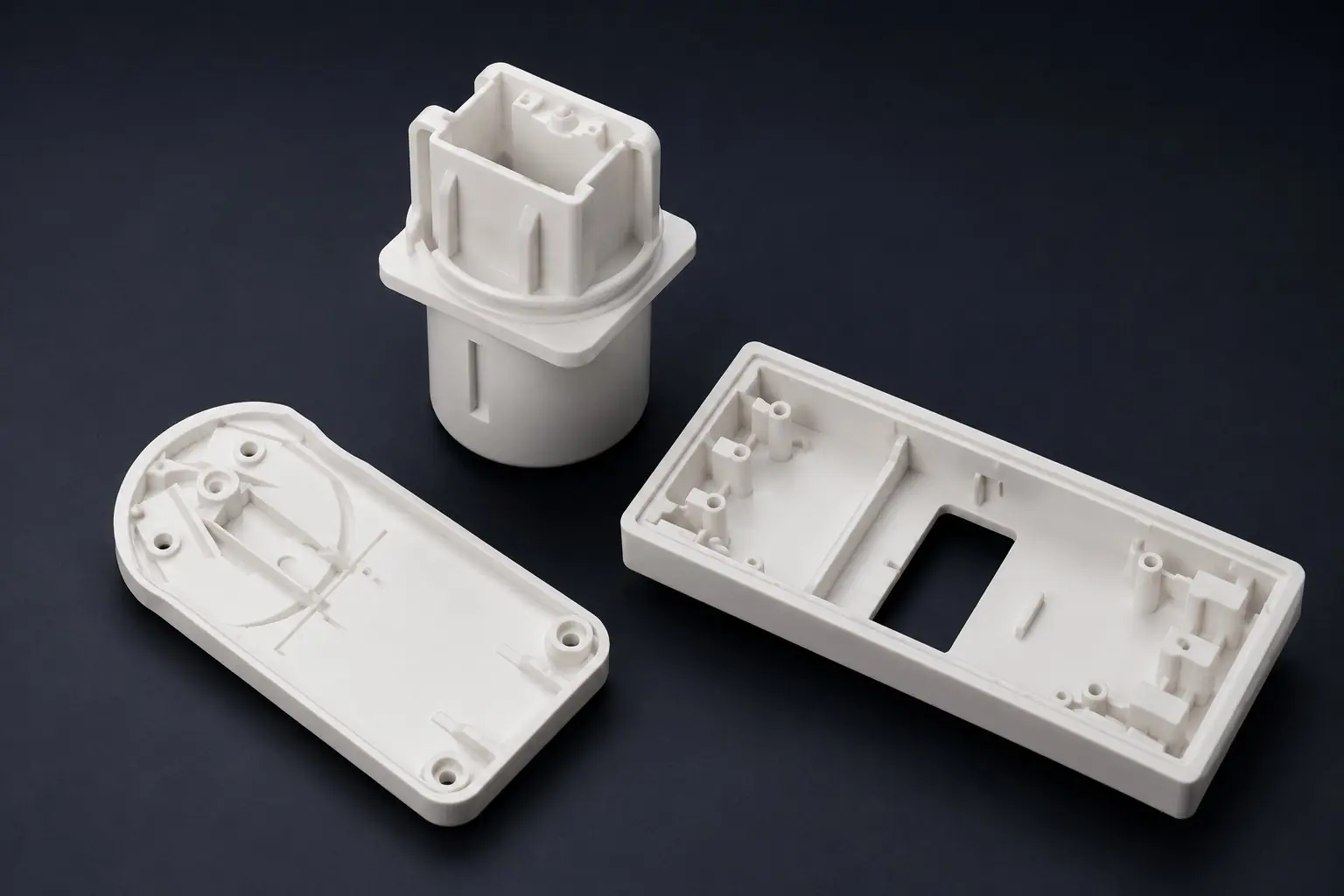
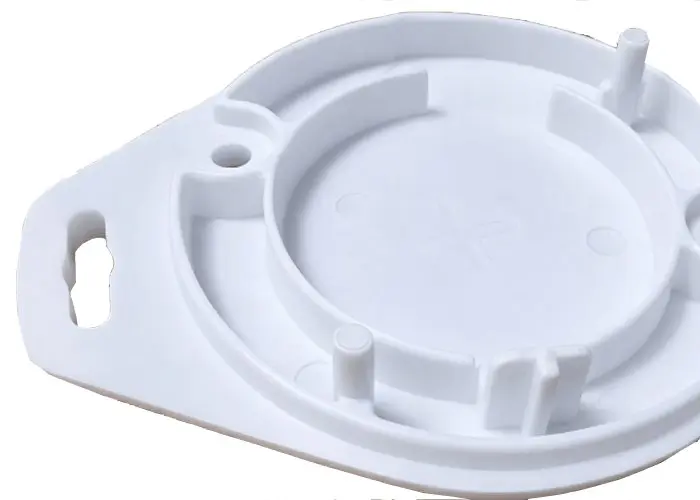
Precision injection moulding of electrical and electronic components in engineering polymers — from PCB housings and connectors to enclosures — with the dimensional control, material expertise, and production consistency these applications demand.
Moldrite provides electrical components injection molding services for OEMs, electronics manufacturers, control panel companies, and industrial equipment manufacturers across India. Electrical and electronic components often demand tighter dimensional control, engineering-grade materials, and greater manufacturing consistency than many general-purpose plastic products. Whether the application involves a PCB housing, connector body, sensor enclosure, terminal cover, or electrical assembly, material selection and manufacturability decisions made early in the project can significantly influence product performance, reliability, and production cost.
Injection molding for electrical components is not simply about producing plastic parts. Factors such as dimensional stability, moisture absorption, heat resistance, assembly fit, wall thickness design, and long-term performance must be considered throughout product development. The correct combination of material selection, mold design, and process control helps reduce tooling iterations and improve production consistency.
As an electrical component molding manufacturer, Moldrite supports OEMs, electronics manufacturers, and product development teams with injection molding of electrical and electronic components using both commodity and engineering polymers. Our capabilities include DFM review, mold development, production, assembly support, and export-oriented manufacturing for a wide range of electrical applications.
Moldrite is an ISO 9001:2015 certified injection molding manufacturer located in Bangalore, India, producing precision injection molded components for electrical, industrial, consumer, automotive, and engineering applications — supporting customers from initial design review through production.
The table below summarizes Moldrite's core capabilities for producing injection molded electrical components — materials, part size range, services, and quality system.
| Capability | Moldrite |
|---|---|
| Materials | PA6, PA6 GF30, PA66, PA66 GF30, PBT, PBT GF30, POM (Delrin), ABS, PC, PC-ABS |
| Part Weight | 0.5g–450g in-house, larger parts through extended manufacturing capacity |
| Services | DFM, Tooling, Production, Assembly Support |
| Industries | Electrical, Electronics, Industrial, Consumer, Automotive |
| Location | Bangalore, India |
| Quality System | ISO 9001:2015 |
Selecting the right material and manufacturing approach early in the project can reduce tooling modifications, improve product reliability, and accelerate production readiness. Whether you are developing a new electrical component, evaluating material options, or preparing for mold development, share your drawings or specifications and our team will respond with how Moldrite can support your project, along with a quotation.
Electrical and electronic products often contain a wide range of injection moulded plastic components that must satisfy mechanical, dimensional, thermal, and assembly requirements. Depending on the application, the material and manufacturing approach may vary significantly.
Moldrite supports the development and production of electrical and electronic components using both commodity and engineering polymers, helping customers move from design and tooling through to production.
Electronic products frequently use injection molded housings to protect internal circuitry while maintaining dimensional consistency for assembly and functional fit.
These components often require controlled dimensions, cosmetic quality, and consistent assembly fit across production batches.
Connector systems frequently operate under demanding conditions involving repeated assembly, vibration, temperature variation, and long service life.
Materials such as PA6, PA66, PA66 GF30, PBT, and PBT GF30 are commonly selected where mechanical strength and dimensional stability are important.
Many modern electrical systems rely on sensors and control devices that require molded plastic components capable of maintaining dimensional accuracy and long-term reliability.
These applications often require careful consideration of material selection, wall thickness, and assembly requirements during the design stage.
Electrical enclosures provide protection against dust, moisture, accidental contact, and environmental exposure while maintaining accessibility for installation and servicing.
Depending on the application, materials may be selected based on impact resistance, dimensional stability, environmental conditions, and mechanical performance.
Many OEM products require application-specific molded components that do not fall into standard categories.
Such components often require close collaboration between product design, material selection, DFM review, tooling, and production planning to achieve the desired performance and manufacturability.
There is rarely a single correct approach to molding an electrical component. The right material, mold design, and process strategy follow from how and where the part will be used — its operating environment, mechanical loading, assembly interfaces, dimensional requirements, and production volume. The sections below walk through how those decisions are made, starting with material selection.
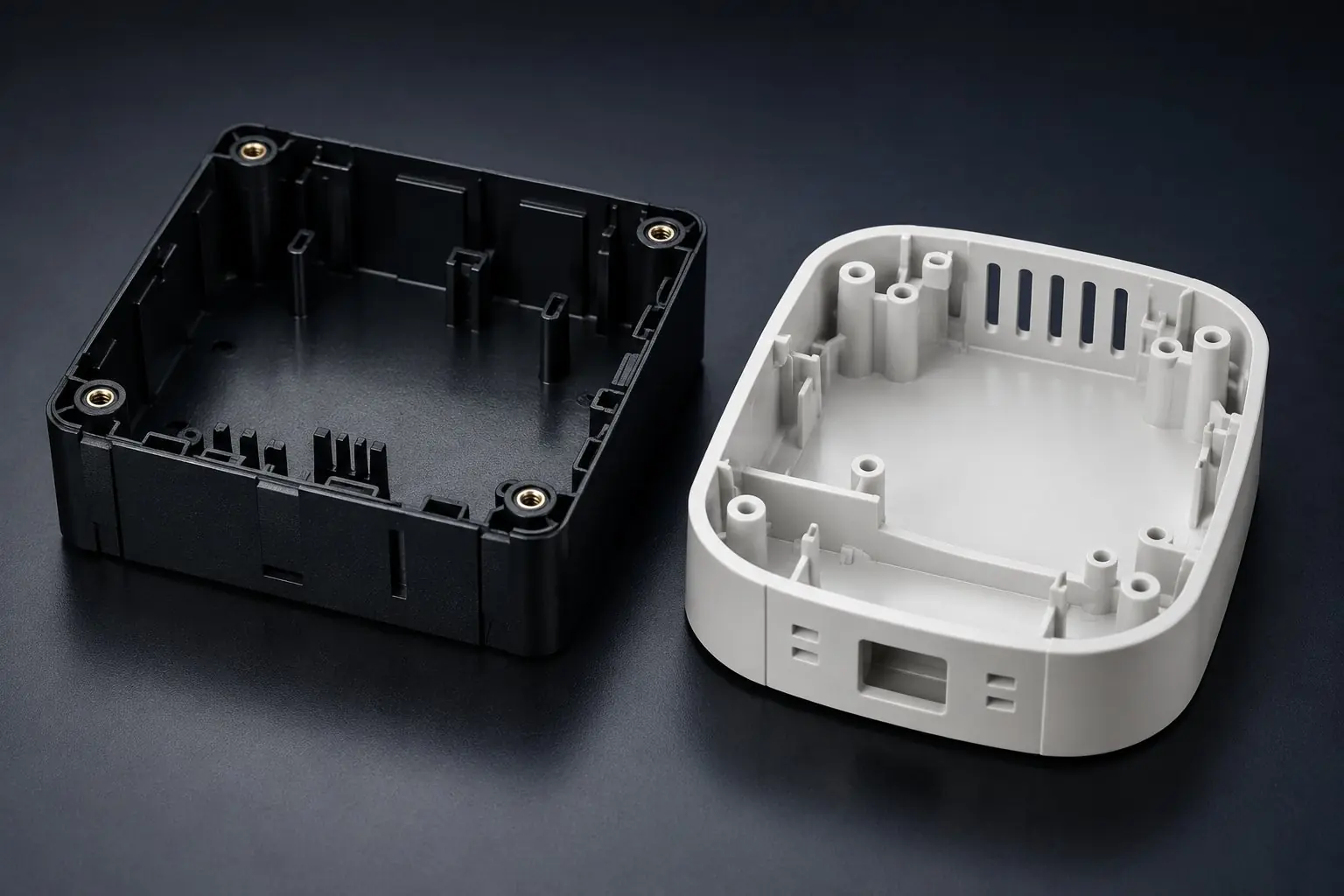
Electrical components often require materials that provide a combination of dimensional stability, electrical insulation, mechanical strength, temperature resistance, and long-term reliability. Material selection should be based on application requirements rather than resin cost alone.
| Component / Application | Typical Material | Why Used |
|---|---|---|
| PCB Housings | ABS, PC-ABS | Impact resistance, dimensional stability, good appearance |
| Electrical Enclosures | PC-ABS, ABS | Strength, heat resistance, durability |
| Connector Bodies | PA66, PA66 GF30, PBT | Electrical insulation, mechanical strength |
| Terminal Covers | PA66 GF30 | Heat resistance and structural rigidity |
| Sensor Housings | PBT, PBT GF30 | Low moisture absorption and dimensional stability |
| Control Panel Components | ABS, PC-ABS | Appearance, dimensional consistency |
| Industrial Automation Components | PA66 GF30, PBT GF30 | Mechanical performance and durability |
| Insulating Components | PA66, PBT | Electrical insulation properties |
| Custom Engineering Components | PA66 GF30, PC, PBT GF30 | Application-specific requirements |
| Material | Common Electrical Applications |
|---|---|
| ABS | Housings, covers, control panels |
| PC-ABS | Electrical enclosures, industrial housings |
| PA6 | Connector and housing components |
| PA6 GF30 | Structural electrical components |
| PA66 | Connectors, terminal components |
| PA66 GF30 | Structural electrical components |
| PBT | Sensor housings, connectors |
| PBT GF30 | Precision electrical parts |
| PC | Transparent covers and specialty applications |
| POM (Delrin) | Precision and low-friction components |
| PP | Non-structural electrical components |
Electrical applications frequently demand tighter dimensional control and higher performance than general consumer products. Engineering polymers such as PA66 GF30, PBT GF30, and PC-ABS are often selected where mechanical loads, elevated temperatures, or long-term dimensional stability are important.
Selecting the correct material early in the project can reduce tooling modifications, improve product reliability, and avoid unnecessary manufacturing costs.
Components located near power electronics, transformers, motors, or heat-generating assemblies may require engineering materials capable of maintaining performance at elevated temperatures.
Connector systems, PCB housings, and assembly-critical components often require stable dimensions to ensure consistent fit and function throughout production.
Certain materials absorb moisture more readily than others. Applications operating in humid environments or requiring tight tolerances should account for moisture-related dimensional changes.
Electrical performance requirements should be evaluated alongside mechanical requirements when selecting a resin for electrical components.
Structural housings, mounting brackets, and load-bearing components may require reinforced materials such as PA66 GF30 or PBT GF30.
Electrical components often contain assembly features, connector interfaces, mounting points, and thin-wall sections that require careful design review before tooling begins.
Large wall thickness variations can increase the risk of sink marks, warpage, and inconsistent cooling.
Connector geometries frequently require precise dimensions to maintain proper engagement and assembly performance.
Many electrical products rely on molded snap fits, clips, and retention features to eliminate secondary fasteners and simplify assembly.
Mounting bosses must be designed to balance strength, moldability, and dimensional stability.
Tolerance capability depends on geometry, material selection, part size, and functional requirements. Critical dimensions should be identified during DFM review so tooling and process strategies can be aligned accordingly.
A structured DFM review before tooling can help identify issues related to gate location, shrinkage, draft angles, wall thickness variation, assembly fit, and moldability. See our DFM review for injection molding →
Electrical components often present manufacturing challenges that are not immediately obvious during product design.
Glass-filled grades such as PA66 GF30 and PBT GF30 lower overall shrinkage compared with unfilled polymers, but because the glass fibres align with the flow direction, shrinkage becomes directional. This difference between flow and cross-flow shrinkage is the main cause of warpage in glass-filled parts, and is managed through part design, gating, and processing conditions.
Multi-cavity tooling requires careful process control to maintain dimensional consistency between cavities.
Electrical components frequently interact with mating parts, fasteners, connectors, or PCB assemblies, making dimensional consistency critical.
Many housings and control panel components have visible surfaces that require consistent appearance and minimal cosmetic defects.
Different materials exhibit different shrinkage characteristics. Material selection, tool design, and processing conditions must be considered together.
Engineering polymers such as PA66 require proper drying and moisture control before processing to maintain part quality and dimensional consistency.
Many production issues attributed to molding are actually created during the design stage. Material selection, wall thickness strategy, gate location, and assembly requirements established before tooling often have a greater impact on final product quality than machine settings alone.
Moldrite supports customers across multiple electrical and electronics sectors.
Manufacturers of electrical assemblies, switchgear components, instrumentation systems, and control products.
Producers of PCB-based products, electronic devices, communication equipment, and embedded systems.
Automation equipment manufacturers requiring precision molded housings, covers, and engineering polymer components.
Custom molded components used in electrical cabinets, control systems, operator interfaces, and industrial equipment.
Plastic housings and functional components for consumer electronic products requiring repeatable cosmetic and dimensional quality.
Electrical component manufacturing requires more than moulding capability. Material selection, DFM review, dimensional control, and process consistency all influence final product performance.
Projects begin with a structured review of geometry, material selection, wall thickness, gating strategy, and manufacturing feasibility before tooling is finalized.
We process engineering materials including PA6, PA6 GF30, PA66, PA66 GF30, PBT, PBT GF30, PC, PC-ABS, ABS, POM (Delrin), and other polymers commonly used in electrical applications. This includes experience with both commodity and engineering polymers for electrical and electronic applications.
Design for Manufacturability reviews help identify potential issues related to shrinkage, warpage, gate location, wall thickness variation, and assembly fit before production begins. Learn more about our DFM review →
Production processes are controlled through documented parameters, dimensional validation, and ongoing quality monitoring throughout production.
Capability ranges from prototype quantities through high-volume production programs depending on project requirements.
Moldrite supplies molded components to customers in multiple international markets including the United States, Australia, UAE, Qatar, Oman, Saudi Arabia, and New Zealand.
One example of our electrical component manufacturing experience involved a precision ABS PCB housing produced for an electronics application requiring dimensional consistency and reliable assembly performance.
The project involved production volumes exceeding 100,000 components while maintaining dimensional consistency across multiple cavities.
Key project considerations included:
Critical functional dimensions were controlled to approximately ±0.02 mm in key functional areas to support reliable assembly and product performance.
The project required consistent assembly fit, cosmetic quality, and dimensional repeatability across production batches, demonstrating the importance of material selection, tooling strategy, and process control in electrical component manufacturing.
Read the full PCB housing case study →Moldrite manufactures precision injection molded components in engineering plastics including PA6, PA6 GF30, PA66, PA66 GF30, PBT, PBT GF30, POM (Delrin), ABS, PC and PC-ABS. Material selection support can be provided during the DFM stage to help optimize manufacturability and long-term performance.
Share your drawings, specifications, or material requirements and our team will get back to you on how we can support your project.
Common materials include ABS, PC, PC-ABS, PA6, PA66, PA66 GF30, PBT, PBT GF30, and POM (Delrin). The appropriate material depends on requirements such as dimensional stability, operating temperature, mechanical strength, electrical insulation, and environmental exposure.
Engineering polymers provide improved dimensional stability, mechanical performance, temperature resistance, and long-term reliability compared to many commodity plastics. Materials such as PA66 GF30 and PBT GF30 are often selected for demanding electrical applications.
Neither material is universally better. PA66 GF30 is often selected where higher mechanical strength and temperature resistance are required, while PBT GF30 is frequently preferred for applications requiring lower moisture absorption and improved dimensional stability.
Connector applications commonly use PA66, PA66 GF30, PBT, or PBT GF30 depending on performance requirements. Material selection should consider dimensional stability, assembly requirements, operating environment, and long-term performance.
Yes. Moldrite supports DFM review, mold development, production, and assembly support depending on project requirements. Early involvement during product development can help identify manufacturability considerations before tooling is built.
Yes. Moldrite manufactures PCB housings, electronic enclosures, electrical housings, connector components, and other molded parts used in electrical and electronic applications.
Achievable tolerances depend on part geometry, material selection, component size, functional requirements, and tooling strategy. Critical dimensions should be identified during the DFM stage so appropriate manufacturing controls can be established.
Yes. Moldrite supplies injection molded components to customers in multiple international markets and supports projects requiring consistent quality, structured execution, and production scalability.
Electrical components often require tighter dimensional control, engineering-grade materials, assembly-critical features, and greater emphasis on long-term reliability than many general-purpose plastic products.