Injection molding cost in India, like anywhere globally, depends on material, tooling, part complexity, and production volume. As a plastic injection molding manufacturer in India, we see this question from OEMs regularly.
For OEMs and product developers, understanding these cost drivers is critical to making the right design and sourcing decisions. Cost is only one side of the equation — how to choose the right injection molding companies in India for your project is equally important.
This guide explains the real cost structure of injection molding, along with practical ways to optimize cost without compromising quality.
A proper DFM review for injection molding early in the design stage helps control cost across both tooling and per-part production.
Typical injection molding cost in India: Mold cost ranges from ₹2 lakh to ₹30 lakh+, and part cost typically ranges from ₹1 to ₹60+ per piece depending on material, design, and production volume.
1. What Determines Injection Molding Cost?
Injection molding cost is not a single number — it is a combination of multiple factors.
Material Cost
Material selection has a direct impact on part cost. The following ranges reflect typical injection molding costs in India based on industry standards and current market conditions.
| Material | Type | Standard Range (₹/kg) | Current Range (₹/kg – Q2 2026)* |
|---|---|---|---|
| PP (Polypropylene) | Commodity | ₹90 – ₹130 | ₹150 – ₹180 |
| HDPE | Commodity | ₹95 – ₹140 | ₹140 – ₹175 |
| ABS | Engineering | ₹160 – ₹220 | ₹200 – ₹280 |
| PA6 (Nylon) | Engineering | ₹200 – ₹300 | ₹250 – ₹350 |
| PA66 GF | Engineering | ₹280 – ₹400 | ₹350 – ₹500 |
| PC (Polycarbonate) | Engineering | ₹250 – ₹350 | ₹300 – ₹400 |
| POM (Delrin) | Engineering | ₹220 – ₹320 | ₹260 – ₹360 |
*Standard range reflects typical pre-2025 market pricing. Current range reflects Q2 2026 pricing impacted by global supply disruptions and geopolitical factors. Actual pricing should be confirmed based on real-time market conditions.
Tooling (Mold) Cost
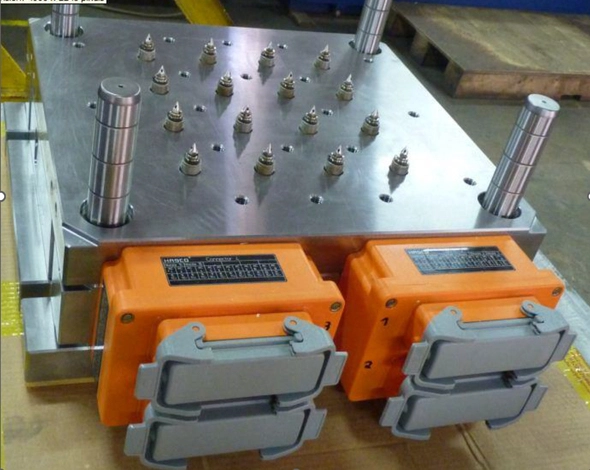
Tooling is a one-time investment, but a major cost component. Typical range in India:
| Mold Type | Typical Cost | Lead Time |
|---|---|---|
| Simple mold (basic geometry) | ₹2,00,000 – ₹8,00,000 | 4–6 weeks |
| Medium complexity (multi-cavity) | ₹8,00,000 – ₹15,00,000 | 6–8 weeks |
| High precision / complex (hot runner, slides) | ₹15,00,000 – ₹30,00,000+ | 8–12 weeks |
Tool cost depends on number of cavities, cooling system design, complexity of geometry, and required tolerances.
India offers a significant cost advantage compared to tooling from Europe, USA, or Japan.
Cost Advantage — Manufacturing in India
Injection molding tooling in India is typically 40–60% lower compared to Europe or the USA for equivalent quality. Combined with competitive labor costs and growing engineering capability, India is one of the most cost-effective sourcing destinations for precision injection molded components.
Production Volume
Volume plays a critical role in cost per part. Low volume means higher per-piece cost. High volume lowers cost due to distribution of tooling investment and cycle time optimization.
Injection molding becomes highly cost-effective at scale.
| Annual Volume | Approx. Per-Part Cost (simple PP part, 10–15g) |
|---|---|
| 1,000 – 5,000 | ₹15 – ₹50 |
| 10,000 – 50,000 | ₹5 – ₹20 |
| 100,000+ | ₹1 – ₹10 |
Note: These are indicative ranges. Actual pricing depends on part geometry, material, tolerance, and finishing requirements. For ongoing projects, material price variation clauses are often considered to manage market fluctuations.
Part Complexity & Design
Complex parts increase both tooling and production cost. Even small design changes can significantly affect cost. Key factors:
- Thin wall sections: Parts below 0.5mm wall thickness require high-speed machines and precise tooling
- Tight tolerances: ±0.02mm vs ±0.1mm — tighter tolerances require high-precision mold manufacturing, better mold steel, controlled processing, and increased quality control. This increases tooling cost, extends mold development time, and requires more stable production control.
- Undercuts and complex geometry: Each slide mechanism adds ₹1L–₹3L to mold cost
- Surface finish requirements: Mirror polish, texturing, or zero gate mark requirements add to mold cost
Beyond the part itself, some applications carry validation costs that affect the overall budget. For instance, agricultural injection molding applications frequently require weathering, impact, and food-contact validation activities that influence total project cost.
2. Typical Injection Molding Cost in India
Here is a practical cost overview for budgeting. Injection molding cost in India is influenced by global polymer markets, which can fluctuate significantly due to crude oil prices, supply chain disruptions, and geopolitical events.
| Cost Component | Typical Range |
|---|---|
| Mold / Tooling | ₹2 lakh – ₹30 lakh+ |
| Simple PP part (high volume) | ₹2 – ₹8 per piece |
| Engineering component (low volume) | ₹25 – ₹60+ per piece |
| DFM / Prototyping (if applicable) | ₹20,000 – ₹2,00,000 |
| Assembly & Packaging | ₹0.50 – ₹5 per part |
Final part cost depends heavily on design, tolerance, and production volume — actual pricing may vary based on project-specific requirements. Contact us with your drawing for an accurate estimate.
3. Understanding Tool Cost vs Part Cost
Many buyers hesitate when they see mold cost. However, in injection molding, tooling is a one-time investment that gets distributed across production volume. Let’s understand this with a practical production example.
Material: PP • Annual volume: 5,00,000 parts • Mold: 8-cavity • Mold cost: ₹5,00,000 • Production cost: ₹5 per piece
Tool cost per part = ₹5,00,000 ÷ 5,00,000 parts = ₹1 per part
Effective part cost = ₹5 (production) + ₹1 (tooling) = ₹6 per piece
This is why injection molding becomes highly cost-effective only at scale. For low-volume requirements, alternative processes like CNC machining or 3D printing may be more economical.
A ₹5 lakh mold may seem expensive upfront, but in a 5 lakh production run, it adds just ₹1 per part.
Scaling Impact on Tool Cost Per Part
The impact of tooling cost reduces significantly as production volume increases:
| Total Production | Mold Cost (₹5L) | Tool Cost Per Part | Production Cost | Effective Part Cost |
|---|---|---|---|---|
| 5,00,000 parts | ₹5,00,000 | ₹1.00 | ₹5.00 | ₹6.00 |
| 10,00,000 parts | ₹5,00,000 | ₹0.50 | ₹5.00 | ₹5.50 |
| 20,00,000 parts | ₹5,00,000 | ₹0.25 | ₹5.00 | ₹5.25 |
For repeat production programs, tooling cost is already absorbed — making future batches significantly more cost-effective.
Actual values may vary based on part design, cycle time, and material.
Not Sure How Your Part Cost Will Scale with Volume?
Share your requirement and we’ll help you estimate. We respond within 24 hours.
Your inquiry is private and handled confidentially.
4. How to Reduce Injection Molding Cost
Cost optimization should be done at design stage, not after tooling.
Optimize Wall Thickness
Avoid unnecessary thickness. Maintain uniform wall sections. This reduces material usage and cycle time. Even a 0.2mm reduction in wall thickness across a high-volume part can save lakhs annually.
Use Multi-Cavity Molds
Multi-cavity molds produce multiple parts per cycle. The mold costs more upfront but the per-part cost drops significantly in high-volume production.
Select the Right Material
Avoid over-specifying materials. If a PP part meets your mechanical and thermal requirements, using PA6 adds unnecessary cost. Match material to actual requirement. A DFM review with your molder can identify material optimization opportunities.
Improve Design for Manufacturing (DFM)
Reduce complexity, eliminate unnecessary features, optimize draft angles. Small design changes can reduce mold cost by 20–30%. Contact us for an injection molding cost estimate — we will review your design for cost optimization opportunities.
For deeper strategies covering design changes, tooling decisions, and process optimization, see our dedicated guide on reducing plastic part cost.
5. Real-World Example: How Precision Affects Cost
In high-precision applications, cost is influenced by tolerance requirements.
A precision ABS electronic housing (~37mm) requiring ±0.02mm tolerance and thin-wall sections (0.30–0.35mm) required advanced tooling design, controlled cooling, and process optimization.
Such requirements increase tooling complexity but ensure consistent fit and performance in production.
Result: 100,000+ parts delivered over 2 years with zero dimensional complaints and 100% PCB fitment consistency.
Read the full case study →
6. Key Takeaways
- Injection molding cost depends on material, tooling, volume, and design
- Tooling is a one-time cost, but design decisions affect long-term production cost
- Cost optimization is most effective during DFM stage
- High precision and tight tolerances increase cost but improve product reliability
- India offers 40–60% cost advantage on tooling compared to Europe/USA
- Raw material prices fluctuate with global crude oil and geopolitical conditions — always confirm current rates
Final Thoughts
Injection molding is one of the most efficient manufacturing processes for high-volume production — but only when designed correctly. Understanding cost drivers helps OEMs make better decisions and avoid unnecessary expenses.
Frequently Asked Questions
What is the average injection molding cost in India?
Injection molding cost in India typically ranges from ₹2 lakh to ₹30 lakh+ for tooling and ₹1 to ₹60+ per part depending on material, complexity, and volume.
Why does injection molding cost vary so much?
Cost varies due to material prices, mold complexity, production volume, and tolerance requirements. High-precision parts and engineering materials increase cost significantly.
How can I reduce injection molding cost?
The most effective approach is optimizing your design for manufacturing (DFM) before committing to tooling. Uniform wall thickness, right material selection, and multi-cavity molds all contribute to lower per-part cost.
Is injection molding in India cheaper than China or Europe?
India offers 40–60% lower tooling costs compared to Europe and the USA. Compared to China, India is competitive on pricing with additional advantages in English communication, IP protection, and growing engineering capability.
If you are new to the process, refer to our injection molding terminology guide to better understand key concepts before scoping a project.
Have a Project in Mind?
Share your drawing for a quick cost estimate and DFM review.
We respond within 24 hours.